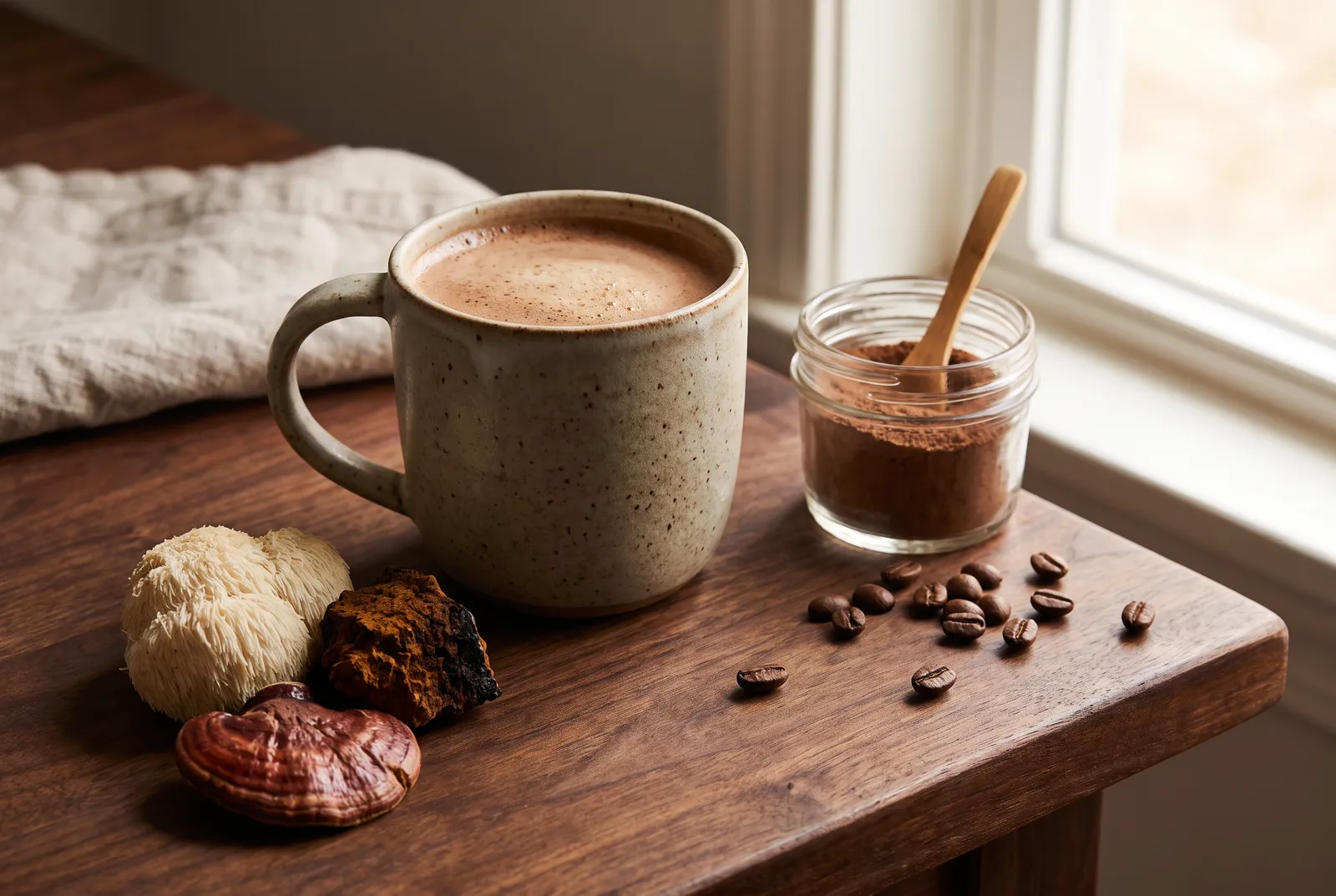
Mushroom coffee has gone from health-food curiosity to a fixture of coffee aisles and social feeds. The pitch is familiar: focus without fog, energy without jitters, a calmer afternoon and a stronger immune system, all thanks to lion's mane, chaga, cordyceps and reishi. Some of that experience may be real. It's just not necessarily coming from the mushrooms.
We read the human trials, safety reviews and labels behind the four headline species. Here's what the evidence supports, where it runs out, and how to shop if you still want a tin.
What's actually in the tin
Most mushroom coffees are instant or ground coffee blended with dried mushroom powder or extract. Some skip coffee altogether. MUD\WTR's Original, for example, combines masala chai, cacao, turmeric and cinnamon with 560 mg each of lion's mane, chaga, reishi and cordyceps, for 2,240 mg of mushrooms per serving [3].
The mushroom part comes in two very different forms:
- Fruiting body: the mushroom itself, or chaga's woody growth on birch.
- Mycelium: the root-like network, often grown in bulk on cooked grain and sold together with that grain as "mycelial biomass."
That distinction matters more than any adjective on the front of the bag. We'll come back to it.
Caffeine: the hidden variable
Before you credit lion's mane for your calm, check the caffeine. Many mushroom coffees replace some coffee with mushroom powder, so a serving can carry far less caffeine than the mug you're used to.
| Drink | Caffeine | Source |
|---|---|---|
| Regular brewed coffee, 12 oz | 113–247 mg | FDA [1] |
| MUD\WTR Original, per serving | About 35 mg | Brand label [3] |
| Four Sigmatic Focus Ground Coffee (Dark), 12 oz cup | About 150 mg | Brand page [4] |
| FDA's level not generally linked to negative effects in most adults | 400 mg per day | FDA [1] |
If you switch from a 12-ounce brewed coffee to a 35 mg blend, you've cut your caffeine by roughly 70–85%. Fewer jitters and a softer comedown are exactly what you'd expect, mushrooms or not. Full-caffeine mushroom coffees exist too, so read the milligrams rather than the mood words.
Tip: If what you want is simply less caffeine, a half-caf blend or a good decaf will do the same job, often for less money. Compare options in mushroom and functional coffee and instant coffee.
Claims vs. evidence, mushroom by mushroom
| Mushroom | Typical claim | Best human evidence we found | Our read |
|---|---|---|---|
| Lion's mane | Focus, mental clarity | One 41-person, 28-day pilot at 1.8 g/day [5] | Intriguing, unproven |
| Cordyceps | Energy, endurance | One small trial of a 4 g/day multi-mushroom blend [6] | Preliminary, industry-funded |
| Reishi | Immune support | Cochrane review: no significant effect on cardiometabolic markers [7] | No support from the trials that exist |
| Chaga | Antioxidants, immunity | No clinical studies of safety or efficacy [9] | Lab and animal data only |
Lion's mane
Brands promise focus and clarity [3][4]. The most relevant recent trial gave 41 healthy young adults either 1.8 g of lion's mane a day or a placebo. A single dose made participants faster on one attention test, the Stroop task, an hour later. After 28 days, though, there was no improvement in overall cognition. Subjective stress showed a borderline trend toward improvement (p = 0.051) on one scale but not on another, and one memory measure actually favored placebo. The manufacturer supplied the product, and the authors call the findings tentative [5].
Dose matters here. That trial used 1.8 g a day. A serving of MUD\WTR's blend contains 560 mg of lion's mane [3], less than a third of the studied amount.
Cordyceps
The pitch is energy and endurance [3]. In a 2017 trial, 28 recreationally active young adults took 4 g a day of a blend or a placebo. The blend was cordyceps mycelium grown on oats plus five other mushrooms. After one week there was no significant difference from placebo. A smaller three-week extension with just 10 people found a rise in maximal oxygen uptake. The study was funded by a nutrition company, and because the product was a blend, cordyceps' own effect can't be isolated [6]. That's an interesting lead, not proof.
Reishi
Reishi is sold mainly for immune support [3]. Immune claims are hard to test directly, and the strongest human data look at other outcomes. A Cochrane review pooled the trials it could analyze: three studies, about 157 adults with type 2 diabetes, taking 1.4–3 g a day for 12–16 weeks. It found no significant changes in blood sugar markers, cholesterol or blood pressure compared with placebo, and it rated the evidence as weak [7]. Memorial Sloan Kettering's herb database also lists case reports of liver injury with powdered reishi, including one death. It notes that reishi can increase bleeding risk and may not be safe for people on immunosuppressants [8].
Chaga
Chaga is marketed for antioxidants and immune support [3][4]. Memorial Sloan Kettering states plainly that its safety and efficacy haven't been evaluated in clinical studies. The research is in cells and animals [9]. The same source describes case reports of serious kidney injury (oxalate nephropathy) in people taking chaga powder for months. It also flags a possible increase in bleeding risk and additive blood-sugar-lowering effects seen in lab studies [9].
Bottom line: No mushroom in your mug has solid human evidence for the benefits on the label. The trials that exist are small, short, often industry-linked, and usually use more mushroom than a serving provides.
Why form and dose matter
Mycelium on grain can mean a lot of starch
When mycelium is grown on oats, rice or sorghum, the grain usually ends up in the powder. A 2025 lab comparison of chaga supplements found that products made from mycelium-fermented grain contained about 33–68% alpha-glucans, mostly starch. Authentic chaga contained about 1%. Beta-glucans, the polysaccharides usually cited for mushroom benefits, ran about 1.0–6.9% in the grain products versus 5.7–11.9% in whole chaga. The grain products also lacked chaga's marker triterpenes [10]. Several of the authors work for a company that sells fruiting-body chaga, which is worth keeping in mind. Still, the measurements make a clear point: an impressive milligram total can be mostly grain.
Labels vary widely. MUD\WTR lists its mushrooms as mycelium cultured on organic oats and/or sorghum, and says it uses both mycelial biomass and fruiting bodies [3]. Four Sigmatic says it uses only fruiting-body extracts, with lion's mane from log-grown mushrooms and chaga with no mycelium or grain [4]. Neither statement proves a benefit, but they describe very different ingredients.
How to read a mushroom coffee label
| Label says | What it usually means | What to look for |
|---|---|---|
| "Proprietary mushroom blend, 2,000 mg" | Total weight only, unknown split | Milligrams for each species |
| "Mycelium," "mycelial biomass," "myceliated" | Mycelium, often with its grain substrate | The substrate named (oats, rice, sorghum) and a starch or alpha-glucan figure |
| "Fruiting body extract" | The mushroom itself, concentrated by extraction | Extraction ratio (such as 8:1) and solvent |
| "Rich in polysaccharides" | Can include starch | Beta-glucan percentage, ideally lab-verified |
| "Not evaluated by the FDA" | A structure/function claim, not an approved benefit | Treat claims as marketing |
| No caffeine number | Unknown dose | Milligrams per serving from the brand |
A short checklist before you buy:
- Species and milligrams per species, compared with doses used in studies (1.8–4 g a day in the trials above [5][6][7]).
- Part used and substrate.
- Measured beta-glucans, not just "polysaccharides."
- Caffeine in milligrams.
- Independent testing for contaminants, published by batch if possible.
Safety notes
Mushroom coffees are mostly sold as foods or dietary supplements, and that carries real limits. The NIH's complementary health center notes that the FDA isn't authorized to review dietary supplements for safety and effectiveness before they're marketed, and that what's on the label may not be what's in the product [2]. It also warns that some supplements interact with medications, that certain ones can raise bleeding risk around surgery, that many haven't been tested in pregnant or nursing women or in children, and that "natural" doesn't always mean safe [2].
For these specific mushrooms:
- Chaga: case reports of kidney injury with long-term use, possible bleeding risk with blood thinners, and possible effects alongside diabetes medication [9].
- Reishi: case reports of liver injury, possible bleeding risk, and potential interference with immunosuppressants [8].
- Caffeine stacking: a mushroom latte plus regular coffee, energy drinks or pre-workout can still push you past the 400 mg a day the FDA uses as a general reference point for most adults [1].
Watch out: If you take anticoagulants or antiplatelet drugs, diabetes medication or immunosuppressants, or have surgery coming up, tell your clinician about any mushroom product before you start, especially chaga or reishi.
Who might still enjoy it
Mushroom coffee can make sense on its own terms:
- Caffeine cutters who want a morning ritual with a fraction of the caffeine.
- Flavor seekers who like earthy, cocoa-and-spice cups. Use the flavor wheel to put words to what you taste.
- Travelers and desk drinkers who want an instant cup that isn't harsh.
Just judge it as a beverage. Does it taste good? Is the price per cup fair? Is the label honest about species, form and caffeine? Those are the things we weigh in our cup scores (see how we score), and they're things you can verify. Better focus and stronger immunity from mushroom coffee are not yet things anyone can promise.
Bottom line: Enjoy mushroom coffee for taste and lower caffeine if that suits you, read the label like a skeptic, and keep your clinician in the loop if you take medications.
FAQ
Does mushroom coffee taste like mushrooms?
Usually not much. Most blends are mainly coffee or cacao, and the mushroom powders add a faint earthy, woody or slightly bitter note rather than a savory mushroom flavor. Coffee-free blends built on masala chai and cacao taste more like a spiced cocoa. Texture can differ, though: some powders leave a little sediment, so stir well.
Is mushroom coffee lower in caffeine than regular coffee?
It depends on the product. Some blends replace part of the coffee with mushroom powder or skip coffee entirely. MUD\WTR's Original lists about 35 mg per serving. Others are full-strength: Four Sigmatic says its Focus ground coffee has about 150 mg per 12-ounce cup. Check the label or the brand's site for milligrams, not adjectives like 'balanced.'
Is lion's mane proven to improve focus?
No. The best recent trial was a small 2023 pilot of 41 young adults taking 1.8 g a day. One dose made people faster on a single attention task, but 28 days produced no overall improvement in cognition. It did show a borderline trend toward lower stress on one scale. Larger, independent trials are needed before anyone can claim a focus benefit.
Who should avoid mushroom coffee?
Talk to a clinician first if you take blood thinners, diabetes medication or immunosuppressants, have kidney or liver disease, are scheduled for surgery, or are pregnant or breastfeeding. Chaga and reishi carry case reports of organ injury and possible drug interactions, and many supplements haven't been tested in pregnancy. Count the caffeine too if you also drink coffee or energy drinks.
References
- [1]Spilling the Beans: How Much Caffeine is Too Much? — U.S. Food and Drug Administration
- [2]Using Dietary Supplements Wisely — National Center for Complementary and Integrative Health (NIH)
- [3]Mud Tin 30 Servings — MUD\WTR
- [4]Focus Ground Coffee - Dark — Four Sigmatic
- [5]The Acute and Chronic Effects of Lion's Mane Mushroom Supplementation on Cognitive Function, Stress and Mood in Young Adults: A Double-Blind, Parallel Groups, Pilot Study — Nutrients (2023), via PubMed Central
- [6]Cordyceps militaris improves tolerance to high intensity exercise after acute and chronic supplementation — Journal of Dietary Supplements, via PubMed Central
- [7]Ganoderma lucidum mushroom for the treatment of cardiovascular risk factors — Cochrane Database of Systematic Reviews (2015), via PubMed Central
- [8]Reishi Mushroom — Memorial Sloan Kettering Cancer Center, About Herbs
- [9]Chaga Mushroom — Memorial Sloan Kettering Cancer Center, About Herbs
- [10]Comparative Study of Chaga (Inonotus obliquus) Dietary Supplements Using Complementary Analytical Techniques — International Journal of Molecular Sciences (2025), via PubMed Central
Discussion
What do you think?
No discussions yet.
Own this article? Ask a question or share your recipe — you’ll be the first.