Walk the tea aisle or scroll a few matcha hauls and you'll see one word on tins at wildly different prices: ceremonial. It sounds like a certification. It isn't. The word tells you what a seller hopes you'll do with the powder, not what's inside the tin.
Grades do exist in practice. A bowl of first-flush, shade-grown matcha tastes nothing like a bag of baking-grade powder from the same country. You just have to judge them on things you can check. This guide explains what "ceremonial" means and doesn't, which quality markers are worth paying for, how usucha and koicha differ, and why prices climbed so fast between 2024 and 2026.
What "ceremonial" actually means
Japan's tea industry does have a written definition of matcha. Under the Green Tea Labeling Standard maintained by the Japan Tea Central Council, matcha is tencha ground to a fine powder with a stone mill or equivalent equipment. Tencha is leaf grown under covers for roughly two to three weeks before plucking, then steamed and dried without rolling [1]. The same document defines "powdered tea" (funmatsucha) separately. That's any tea pulverized in a grinder, and it isn't matcha [1].
What the standard doesn't contain is a ceremonial grade. It goes further and lists vague, unsupported terms such as "finest," "top grade," "deluxe" and "special" as improper labeling [1]. It also says autumn-plucked tencha and similar leaf is "food-processing tencha," meant for food manufacturing [1]. That's the closest thing to an official line between drinking and cooking matcha.
So outside Japan, "ceremonial" is a seller's own description. Some respected producers barely use it. Ippodo's online lineup, for example, sorts matcha by strength (rich, balanced or light) rather than by ceremonial or culinary [4].
The chemistry does back up the idea of grades. Researchers at NARO, Japan's national agriculture research organization, compared commercial matcha. Tea-ceremony matcha had at least 1.8 g of theanine per 100 g of dry matter, plus more chlorophyll and a higher ratio of key catechins than most food-use matcha. On those same measures, food-use matcha and generic powdered green tea were hard to tell apart [5]. Real differences exist. The label just doesn't guarantee them.
Bottom line: Read "ceremonial" as a claim to verify, not a grade. The proof is in harvest, origin, milling, freshness and price.
The quality markers that matter
Color
Good matcha is a vivid, slightly bluish jade. Shading boosts chlorophyll, and the NARO study found the highest chlorophyll levels in tea-ceremony matcha [5]. Dull olive, khaki or yellow-brown powder points to later harvests, more sun, stems in the blend, or age and heat. Judge color in daylight, on white paper, next to a tin you trust.
Aroma and taste
Shading raises amino acids such as theanine, along with carotenoids. Those compounds help create the sweet, seaweed-like "covered" aroma of good matcha, including dimethyl sulfide and ionone-type notes [6]. In the cup, a fine usucha is savory-sweet, with bitterness at the edges rather than in the middle. Harsh bitterness and a drying finish suggest a lower grade, or water that's too hot.
Origin
Uji in Kyoto carries the prestige, but production has shifted. In Japan's 2025 statistics, Kagoshima ranked first for tencha, Kyoto second and Shizuoka third [2]. A Kagoshima matcha isn't inferior by default. Just look for specifics. Under Japan's labeling standard, a regional name such as "Uji" requires at least 50% leaf from that region, and anything less than 100% must be marked as a blend [1]. That rule governs the Japanese market, not every import. Japan's agriculture ministry reports a rise in infringements such as Chinese-made "Uji matcha," which is one reason "Japanese tea" won geographical-indication protection on July 10, 2026 [2].
Harvest
First flush (ichibancha) is the spring pluck, and it's the backbone of drinking-grade matcha. Prices show the gap clearly. In 2025, first-flush tencha averaged ¥10,030 per kilogram at the crude-tea stage, against ¥4,950 for second flush [2]. A tin that names its harvest is making a checkable claim. A tin that names nothing usually has a reason.
Cultivar
Many top matcha powders are blends, which is the craft of a tea master. Others name a single cultivar such as Okumidori, Samidori or Asahi. Japan's tea fields are still dominated by Yabukita, which covers 64% of planted area nationally. Kyoto leans more on cultivars often used for shaded tea, with 13% Okumidori and 10% Samidori [2]. A named cultivar shows transparency, but it doesn't guarantee quality.
Milling
Stone mills grind tencha to roughly 1–20 micrometers [7]. They're slow, and that's part of the cost. The industry standard also accepts other equipment that grinds the way a stone mill does [1], so a "stone-ground" claim can't be checked by eye. Texture can. Good matcha feels silky between your fingers, clings to the tin and whisks into a fine, even foam without grit.
Freshness
Matcha is ground leaf with a huge surface area, so it fades quickly. Favor small, opaque, sealed packages with a production or best-by date, and buy what you'll finish within a few weeks of opening.
Price per gram: the fastest reality check
Shelf prices mean little until you divide by weight. A single producer's lineup shows how wide the range really is. Here is Ippodo's global store as listed in mid-October 2026, all in 20 g boxes [4]:
| Matcha (Ippodo) | Strength label | Price per 20 g | Price per gram | Per 2 g bowl |
|---|---|---|---|---|
| Kanza | Rich | ¥15,000 | ¥750 | ¥1,500 |
| Kuon | Rich | ¥9,000 | ¥450 | ¥900 |
| Ummon-no-mukashi | Rich | ¥5,000 | ¥250 | ¥500 |
| Sayaka-no-mukashi | Rich | ¥2,800 | ¥140 | ¥280 |
| Kan-no-shiro | Balanced | ¥2,000 | ¥100 | ¥200 |
| Ikuyo-no-mukashi | Balanced | ¥1,400 | ¥70 | ¥140 |
| Hatsu-mukashi | Light | ¥800 | ¥40 | ¥80 |
That's a roughly 19-fold spread inside one Kyoto tea house. Three rules follow from it:
- Compare within a brand first. If a company's "ceremonial" costs the same per gram as its latte powder, ask what's different.
- Be wary of bargain ceremonial. Shaded, first-flush tencha is expensive before it's even milled. In 2025, tencha's average price ran about 4.9 times that of sencha [2].
- Price per serving keeps it sane. At 2 g per bowl, even a pricey tin often costs less per cup than a café latte.
Tip: Write the price per gram on the lid with a marker. After a few tins, you'll know which tier you actually enjoy, and whether the expensive one earns its place.
Usucha vs. koicha: different drinks, different grades
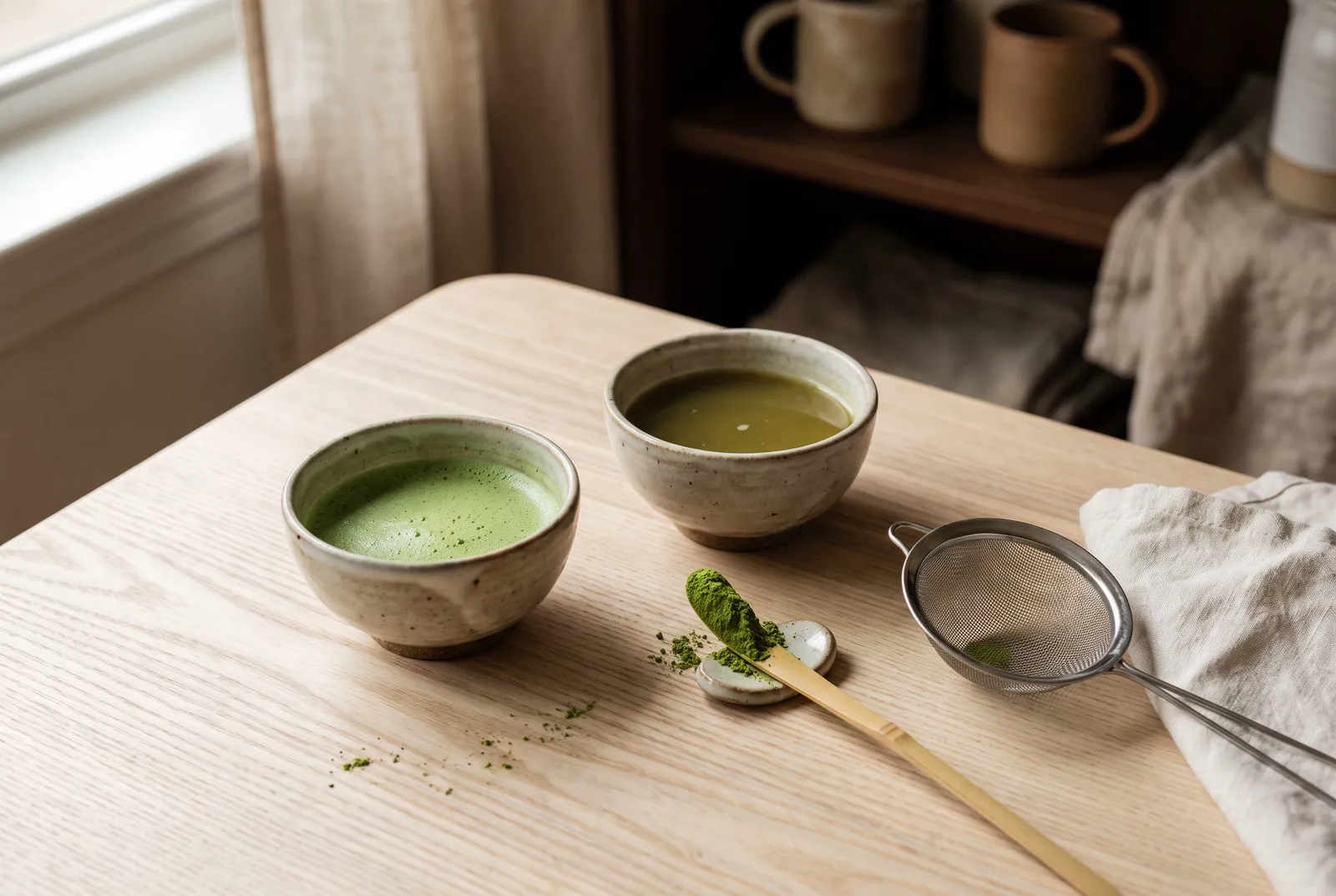
Most people outside Japan drink usucha, or thin tea. Koicha, or thick tea, is the heart of the formal tea ceremony, and it's where grade matters most.
| Usucha (thin) | Koicha (thick) | |
|---|---|---|
| Matcha | 2 g, sifted | 4 g, sifted |
| Water | 60 ml at 80 °C | 30 ml at 80 °C |
| Technique | Whisk vigorously, about 15 seconds | Whisk slowly, almost kneading, about 15 seconds |
| Texture | Light, frothy | Glossy, paint-like, little or no foam |
| Grade needed | Good usucha grades and up | The sweetest, least bitter top grades |
Koicha doubles the powder and halves the water, so bitterness concentrates. Only very sweet, umami-rich matcha stays pleasant at that strength. If a "ceremonial" matcha tastes harsh as koicha, it's an usucha or latte grade with a fancy label.
Culinary matcha isn't a dirty word
For lattes, baking, smoothies and ice cream, a sturdier and more astringent matcha is often the right choice. Milk, sugar and fat flatten subtle sweetness, and a bolder powder cuts through them at a fraction of the cost. The catch is that "culinary" can also mean powdered sencha or stems. Check the ingredient line for matcha rather than "green tea powder," because under Japan's standard those are different products [1].
Watch out: "Latte grade" blends are sometimes pre-sweetened. If sugar or milk powder comes before matcha in the ingredients, you're buying a mix, not matcha.
Why matcha got scarce (2024–2026)
Demand outran a slow crop
Ippodo puts the surge in global demand at around 2024 [3]. The export numbers show the scale. Japan's green tea exports went from ¥36.4 billion in 2024 to a record ¥72.1 billion in 2025. Powdered tea, including matcha, made up 84% of that value. The United States was the largest market at 4,431 tonnes [2]. Exports for January through August 2026 ran ahead of the 2025 pace [2].
Supply can't simply scale
Growers responded. Tencha output reached 6,278 tonnes in 2025, about 3.2 times the 2014 level [2]. Tea is a perennial crop, though, and new fields take about five years to yield [3]. Meanwhile:
- The number of individual tea-growing operations fell from 12,325 in 2020 to 7,726 in 2025 [2].
- About 40% of Japan's tea fields are more than 30 years old, which raises concerns about yield and quality [2].
- First-flush output across all teas dropped from 28,708 tonnes in 2024 to 25,213 tonnes in 2025 [2].
- Tencha needs shading structures and dedicated drying lines, so switching takes money and time. The ministry now subsidizes covering materials for growers converting to tencha [2].
The squeeze spread to other teas
As growers shifted toward matcha, production of gyokuro, sencha and bancha fell in 2026 and their market prices rose sharply. Ippodo introduced purchase limits on bancha in February 2026 [3]. Across Japan, 2026 first-flush tea traded at about double the previous year's price in Kagoshima and about 70% higher in Shizuoka [2].
Where prices go next
Ippodo expects prices to stay broadly near current levels for some time, with year-to-year swings [3]. That's a realistic planning assumption for buyers.
What it means for you
- Expect higher prices and smaller tins. Some producers are also adjusting product specifications alongside prices [3].
- Don't hoard. Matcha loses color and aroma within weeks of opening, so a stockpile often goes stale.
- Demand specifics. Look for prefecture or city, harvest, cultivar or blend, packing date and a real ingredient line.
- Match grade to use. Pay for flavor where you'll taste it, in straight usucha or koicha, and economize in lattes.
- Use the tools. Compare matcha and latte powders side by side in our matcha category and matcha drinks, see how cup scores are built on how we score, and train your palate with the flavor wheel.
Bottom line: Good matcha proves itself in color, aroma, sweetness and a transparent label, not in the word "ceremonial." Buy the grade the drink deserves and judge it by price per gram.
FAQ
Do I need ceremonial matcha for a latte?
No. Milk and sweetener mute the delicate sweetness and marine aroma you pay for in top grades, so a sturdier, slightly more astringent matcha usually tastes better in a latte and costs far less. Save expensive first-flush powder for straight usucha or koicha, where every nuance shows. Just make sure the latte grade is still labeled matcha, not generic green tea powder.
Is matcha from Kagoshima worse than matcha from Uji?
Not automatically. Kagoshima is now Japan's largest tencha-producing prefecture, ahead of Kyoto and Shizuoka, and it grows plenty of excellent tea. Uji carries centuries of prestige and a deep blending tradition. Judge the specific powder on harvest, cultivar, color, aroma and freshness rather than on a place name alone, and check that origin claims are specific.
How can I tell if matcha is fresh?
Look for a production or best-by date, a small, opaque, sealed tin or pouch, and a bright jade color when you open it. Fresh matcha smells sweet and grassy, sometimes with a seaweed-like note. Dull olive or brownish powder and a hay-like or flat smell suggest age or heat exposure. Once opened, keep it sealed and cool and use it within a few weeks.
Why did matcha prices rise so fast?
Demand jumped faster than Japan could grow shaded tea. Green tea exports nearly doubled from 2024 to 2025, mostly as powdered tea, while new tea fields take about five years to yield, the number of tea farms kept falling, and first-flush output dipped. Growers shifting to tencha also pushed up prices of other Japanese teas.
References
- [1]緑茶の表示基準 (Green Tea Labeling Standard) — Japan Tea Central Public Interest Incorporated Association (日本茶業中央会)
- [2]茶をめぐる情勢 (The Situation Surrounding Tea), October 2026 — Ministry of Agriculture, Forestry and Fisheries of Japan
- [3]Oct./Nov. 2026: Revisions to Product Specifications and Pricing — Ippodo Tea
- [4]Matcha, Uji-Shimizu — Ippodo Tea
- [5]Chemical Components of Matcha and Powdered Green Tea — Journal of Cookery Science of Japan (J-STAGE)
- [6]抹茶の特徴 (Characteristics of Matcha) — Journal of Japan Association on Odor Environment (J-STAGE)
- [7]The proper way to brew Nihoncha — Ministry of Agriculture, Forestry and Fisheries of Japan
- [8]Basic Usucha (Matcha) — Ippodo Tea
- [9]Basic Koicha (Matcha) — Ippodo Tea
Discussion
What do you think?
No discussions yet.
Own this article? Ask a question or share your recipe — you’ll be the first.