Here is an unpopular opinion among people who sell drippers: the grinder matters more than the brewer. We would take an inexpensive plastic cone fed by a good burr grinder over a gorgeous glass brewer fed by a blade grinder, and once you understand what happens inside the coffee bed, you probably would too.
Why grind quality controls extraction
Water dissolves coffee from the outside of each particle inward. Small particles give up their soluble compounds quickly; large ones release them slowly. A grind with a wide spread of sizes therefore overextracts the small pieces while underextracting the big ones, and the cup can taste bitter and sour at the same time. No brewing technique fully rescues a bad particle mix.
No grinder makes identical particles, either. When astrophysicist and coffee researcher Jonathan Gagné analyzed about 300 particle size distributions from 24 espresso grinders, collected by the Kaffeemacher team and a researcher at the Zurich University of Applied Sciences, every grinder produced a population of fines alongside its main peak, and the data fit a three-part model spanning roughly 10 to 1,200 microns [2]. His most practical conclusion: when you dial in espresso, you are adjusting the amount of fines more than the average size of the coarse particles [2].
Bean temperature matters, too. A 2016 study in Scientific Reports, with a co-author from grinder maker Mahlkönig, ground beans at four temperatures on a commercial grinder. Colder beans produced a narrower distribution and smaller particles, with the most common particle size falling by about 31% between room temperature and liquid nitrogen. Coffees from four origins and different processing methods ground almost identically [4]. The authors suggest warming burrs may explain why baristas often grind finer as a busy day goes on [4].
Blade grinders: fast, cheap and uneven
A blade grinder is a small motor spinning a propeller-shaped blade. It does not grind to a size; it shatters beans, and nothing stops a piece from being hit again once it is small enough. How fine the coffee ends up depends on how long you hold the button and how you shake the chamber.
Gagné's advice in his V60 guide is blunt: "avoid blade grinders at all costs." They create an extremely wide particle size distribution and can overheat the grounds [1]. Burr grinders, he notes, generally produce a narrower spread [1].
If a blade grinder is what you have:
- Grind in short pulses and shake the grinder between them.
- Grind only what you need, right before brewing.
- Favor immersion brewers such as the French press, which tolerate an uneven grind better than pour-over or espresso.
- Plan an upgrade. A capable hand burr grinder like the Timemore Chestnut C3S starts at $89 [8].
Burr grinders: how they work
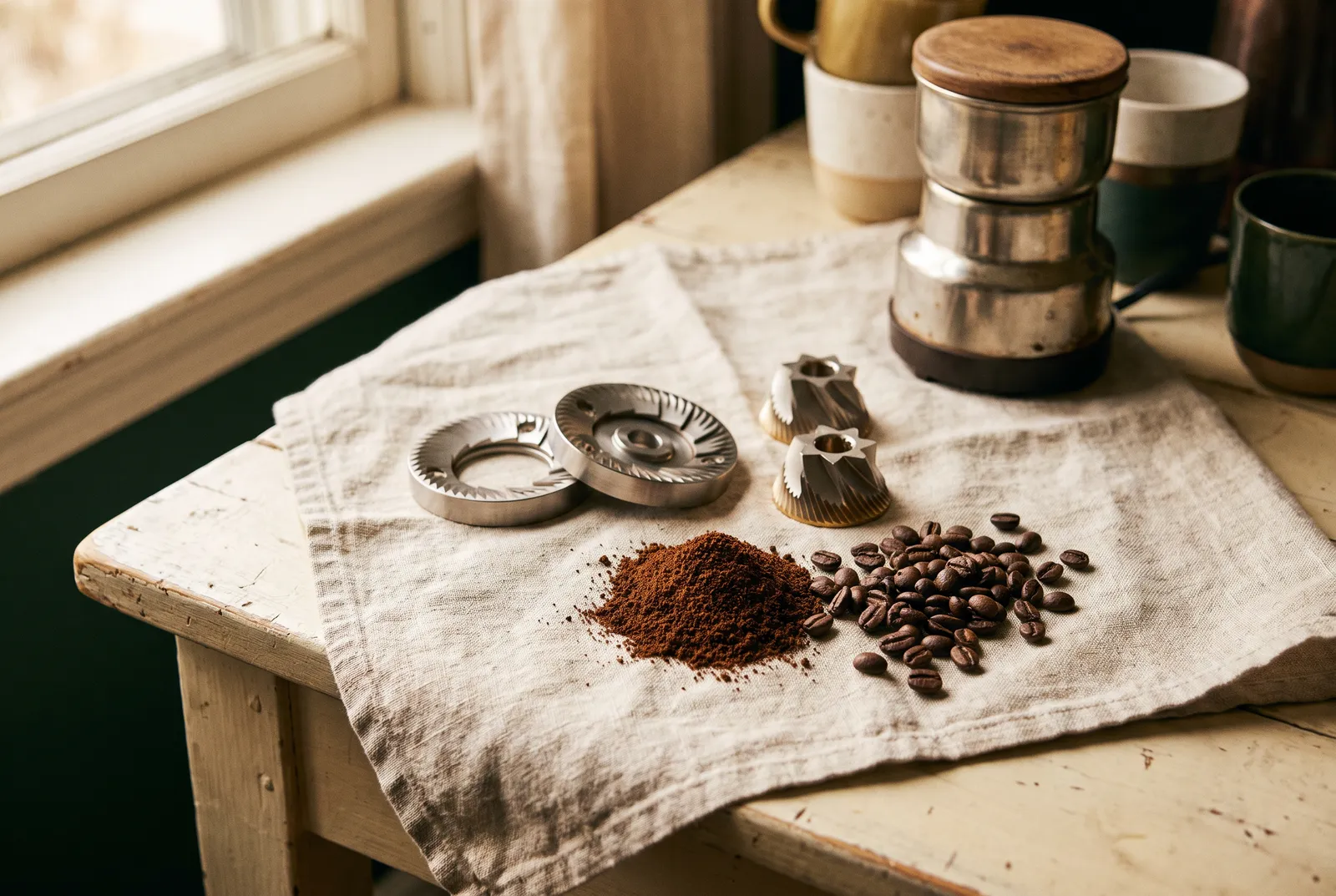
A burr grinder crushes beans between two hardened surfaces, one fixed and one adjustable. Particles can only leave once they are small enough to pass through the gap, so the gap setting, not the timer, decides how fine the coffee is. That single design choice is why burr grinders are repeatable.
Flat vs. conical
Flat burrs are two parallel rings that grind outward from the center. Conical burrs nest a cone inside a ring and grind downward. The lab data and the manufacturer view line up better than you might expect.
In Gagné's 24-grinder analysis, conical burrs were on average less unimodal (more fines) and less uniform than flat burrs, with a large overlap between the two groups [2]. Burr size was not a clear predictor: the 50 to 70 mm flat burrs did not get more uniform as they got bigger, and he concluded that geometry may matter more than diameter [2]. Most telling, the grinders the Kaffeemacher tasters rated highest sat in the middle of the pack on both measures [2]. Uniformity is a means, not the goal.
Baratza, which sells both styles, describes conical burrs as round and sweet in the cup and slightly more forgiving thanks to their fines, with lower retention, and flat burrs as clean and articulate, a good match for single-origin espresso. Its summary: no burr type is better; each emphasizes different qualities [3]. The same guide describes steel burrs as clean and highly consistent and ceramic burrs as rounder and more traditional for espresso [3].
| Conical burrs | Flat burrs | |
|---|---|---|
| Particle spread in lab data | Wider on average, more fines [2] | Narrower on average [2] |
| Flavor tendency, per Baratza | Round, sweet, forgiving [3] | Clean, articulate [3] |
| Retention, per Baratza | Lower [3] | Depends heavily on grinder design |
| Where you usually find them | Most hand grinders and many entry-level electrics | Many brew-focused and single-dose grinders |
Retention, static and single dosing
Retention is the coffee that stays inside the grinder after you finish. It goes stale and falls into your next dose, and it makes the weight that comes out differ from the weight you put in.
Static is a big part of the problem. A 2024 study in iScience found that grinding generates substantial charge, that darker roasts charge more strongly, and that residual moisture in the beans sets the polarity, with a switch near 2% moisture. Charge on light-roast grounds faded in about 15 seconds, versus about 65 seconds for dark roasts [5]. Adding water to the whole beans before grinding cut charge by at least 50 to 60% at doses up to 30 microliters per gram, reduced clumping and freed fines stuck inside the grinder. At 10 microliters per gram, retained grounds fell from about 12% to about 2.5%. Ionizers, by contrast, reduced or neutralized charge but did not change particle size or retention [5].
Tip: Try the water trick with a single dose: a light mist or a few drops of water stirred into the beans. For 18 g of coffee, 10 microliters per gram is only 0.18 mL. Check your grinder's manual first, since some manufacturers advise against adding moisture.
Single-dose grinders, which you load with one weighed dose at a time, are designed around low retention. Some people worry that grinding without the weight of a full hopper on top hurts grind quality, but the evidence says otherwise. In a test on a Baratza Forté, a 10 g dose ground from an otherwise empty hopper was virtually indistinguishable from 10 g ground from a full hopper; only feeding beans one at a time made a measurable difference, about five clicks coarser [6]. Gagné's verdict: don't be afraid to grind single doses [6].
Adjustment: stepped vs. stepless
How finely a grinder adjusts matters as much as how well it grinds, especially for espresso. Stepped grinders click between fixed positions, which makes settings easy to repeat. Stepless grinders adjust continuously and are usually built for a single purpose, most often espresso [7].
Baratza's numbers show why resolution matters. The original Encore has 40 evenly spaced steps. The Encore ESP splits its dial in two: settings 21 to 40 cover filter brewing on a steep ramp, while settings 0 to 20 cover espresso on a shallow ramp, so each click moves the burr only slightly. According to Baratza, a change of a few dozen microns can shift espresso shot time by several seconds [7].
For pour-over, ordinary steps are fine; a one-click change is a small taste adjustment. For espresso, you want either very fine steps in the espresso range or a stepless collar.
Hand vs. electric
At the same price, a hand grinder usually buys better burrs and a sturdier adjustment mechanism than an electric one, because you are supplying the motor. The trade-offs are effort and time: cranking a light roast for a large Chemex batch every morning gets old, and hand grinders are less pleasant for very fine espresso settings. Electric grinders win on speed and on brewing for several people. A sensible pattern is a hand grinder for travel or a first setup, then an electric grinder once you know which brew method you actually use most.
Is your grinder the problem?
A few symptoms point at the grinder rather than your technique:
- Pour-over that tastes muddy and bitter yet sour, with a slow, stalling drawdown. That often means a large fines population clogging the filter. Coarsen the grind a step; if the problem persists across coffees, the grinder may be producing too many fines for that method.
- Espresso shot times that wander by several seconds with no change in setting. Check retention and static first. Purge a little coffee, try the water trick, and weigh what comes out against what goes in [5].
- Espresso that is sour and bitter at once, with spurts from a bottomless portafilter. That is channeling, which Baratza notes is usually a puck prep issue rather than a grinder fault [3].
- Shots that run faster as a long session goes on. Heat may be the cause. Warmer beans grind into larger, more widely spread particles, which the 2016 study's authors suggest may be why baristas end up grinding finer as the day goes on [4]. Recheck your setting after several doses in a row.
What to spend: pour-over vs. espresso
Pour-over, drip and French press forgive a lot. Espresso forgives almost nothing. That difference should drive your budget.
| Budget | Example and list price | Best for | Keep in mind |
|---|---|---|---|
| Under $100 | Timemore Chestnut C3S, from $89 [8] | Pour-over, AeroPress, French press | Hand cranking; not an espresso specialist |
| About $200 | Baratza Encore ESP, $199.95 [9] | Filter brewing plus entry-level espresso | Espresso adjustment is stepped, though in small increments [7] |
| About $400 | Fellow Ode Brew Grinder Gen 2, $399.95 [10] | Pour-over and batch brew on 64 mm flat burrs | The maker states it is not intended for espresso [10] |
| $200 to $400 and up | Espresso-focused hand grinders and single-dose electrics | Espresso with fine or stepless adjustment | Confirm the espresso range and retention before buying |
Prices are list prices from the makers' sites at the time of writing. For espresso-focused options, such as hand grinders with fine espresso adjustment and single-dose flat-burr electrics, compare current models and prices in our grinders category.
Our rules of thumb:
- Pour-over only: a quality hand grinder under $100 gets you most of the way. Spend more for speed and convenience, or for a flat-burr brew grinder if you want maximum clarity.
- Espresso: treat the grinder as half the system. We would rather see an entry-level machine paired with a capable espresso grinder than the reverse. Browse espresso machines only after you have the grinder sorted.
- Both: a dual-range grinder works, but if one method dominates your mornings, buy for that method.
Fellow's Ode Gen 2 is a useful illustration of specialization: a 64 mm flat-burr grinder with 11 settings and 31 total steps, sold with low-retention and single-dose features, explicitly not intended for espresso [10]. Specialized grinders are better at their job precisely because they give up the other one.
Bottom line: A burr grinder is the single best upgrade for most home coffee setups. Flat or conical matters less than build quality, adjustment and how well the grinder fits your brew method. For pour-over, spend modestly and brew happily; for espresso, put the grinder ahead of the machine in your budget.
See how we score gear on performance, build and usability, or explore the full directory.
FAQ
Is a blade grinder better than buying pre-ground coffee?
It is a trade-off. Freshly ground coffee from a blade grinder keeps more aroma, but the particle sizes are all over the place, which muddies extraction. Pre-ground coffee from a good roaster is made on commercial grinders and is more even, but it stales quickly once opened. If you use a blade grinder, pulse briefly, shake between pulses and favor forgiving immersion brewers like the French press.
Flat or conical burrs for espresso?
Both make excellent espresso. Lab data from 24 espresso grinders found flat burrs averaged slightly more uniform, less fines-heavy grinds, but with plenty of overlap, and the best-tasting grinders in that set were not the most extreme on either measure. Baratza describes conicals as round, sweet and forgiving and flats as clean and articulate. Choose for workflow, adjustment and budget first.
Do I need a single-dose grinder?
Only if you switch beans often or brew small amounts. Single-dose grinders are built to keep little coffee inside, so each dose comes out fresh and close to the weight you put in. Grinding from a full hopper does not hurt grind quality, though: one test found a 10 gram dose ground from an empty hopper was nearly indistinguishable from the same dose ground from a full one.
Can one grinder handle both espresso and pour-over?
Yes, with caveats. Dual-range grinders such as the Baratza Encore ESP use fine steps for espresso and larger ones for filter, so switching is quick. The catch is that very good espresso and very good pour-over reward different burr designs and adjustment styles. If you mostly drink one or the other, a grinder specialized for that method will usually serve you better.
References
- [1]How to Brew Better Coffee with a V60 — Coffee ad Astra (Jonathan Gagné)
- [2]What I learned from analyzing 300 particle size distributions for 24 espresso grinders — Coffee ad Astra (Jonathan Gagné)
- [3]Dialing in Espresso: Burr Types, Adjustments, and Troubleshooting — Baratza
- [4]The effect of bean origin and temperature on grinding roasted coffee — Scientific Reports
- [5]Strategies to mitigate electrostatic charging during coffee grinding — iScience, via PubMed Central
- [6]Grind Quality and the Popcorning Effect — Coffee ad Astra (Jonathan Gagné)
- [7]Stepped vs. Stepless: Which is Right for Your Grind? — Baratza
- [8]TIMEMORE CHESTNUT C3s - Jet Black — Timemore
- [9]Encore™ ESP — Baratza
- [10]Ode Brew Grinder Gen 2 — Fellow
Discussion
What do you think?
No discussions yet.
Own this article? Ask a question or share your recipe — you’ll be the first.