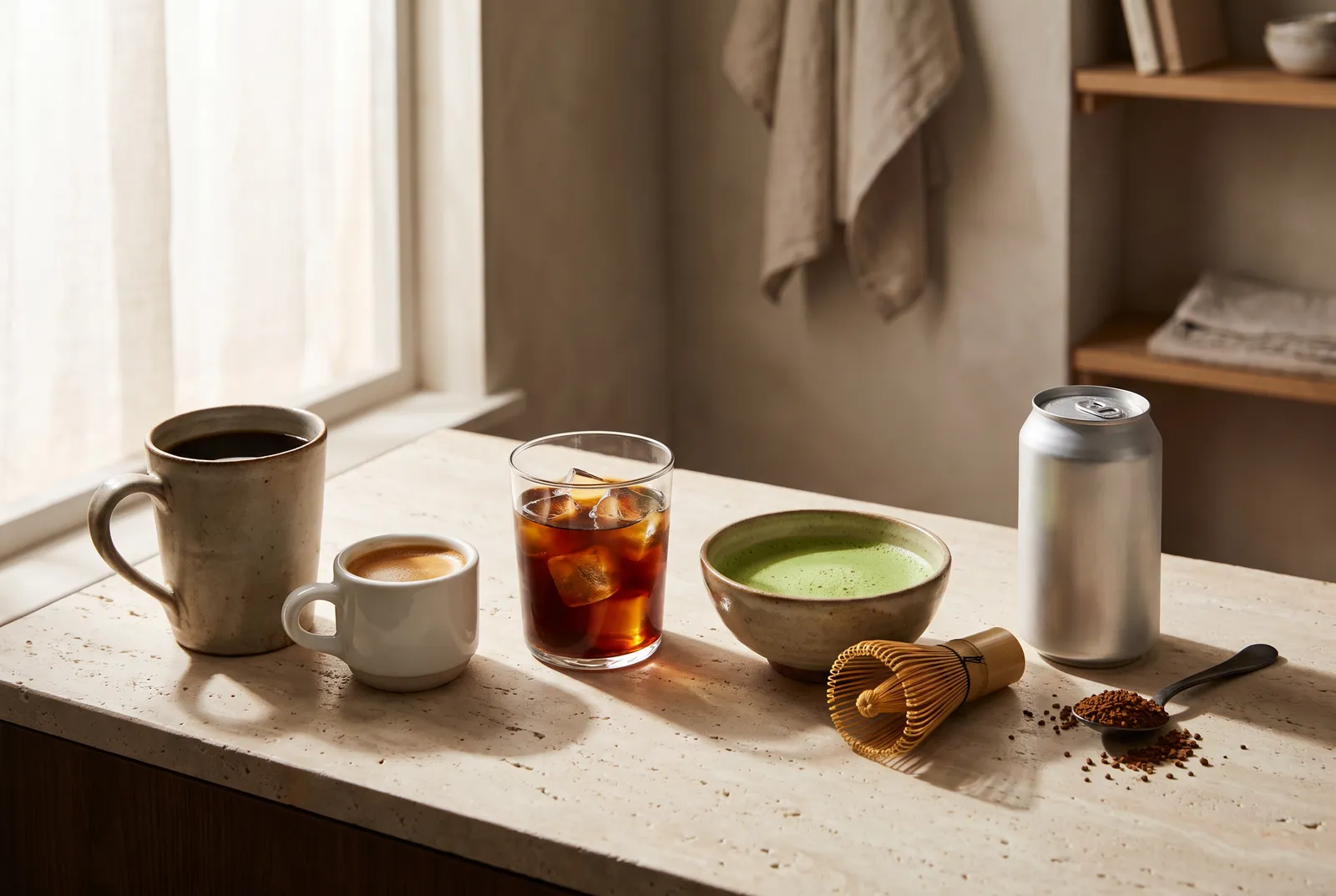
"How much caffeine is in a cup of coffee?" sounds like a simple question. The honest answer is that it depends mostly on two things: how much coffee went into the drink and how big the drink is. Bean species, brew method and the barista's hand on the grinder all play a part, but serving size and dose do most of the work. Here are the numbers from federal databases, peer-reviewed studies and the labels themselves, plus the guidance on how much is too much.
The quick answer
| Drink | Serving | Caffeine | Source |
|---|---|---|---|
| Brewed (drip) coffee | 12 fl oz | 113–247 mg | FDA [1] |
| Espresso | 1 fl oz single shot | About 63 mg | USDA [3] |
| Espresso as served in cafes | 1 serving | Sixfold range across 20 shops, up to 322 mg | Crozier et al. [5] |
| Instant coffee | 1 tsp (1 g) or a 2 g packet | About 31 mg or 63 mg | USDA [4] |
| Canned nitro cold brew | 1 can (High Brew) | 200 mg | Label [10] |
| Canned latte | 9 fl oz (La Colombe) | 100 mg | Label [9] |
| Matcha | 2 g of powder | About 38–89 mg | Calculated from [8] |
| Black tea | 12 fl oz | 71 mg | FDA [1] |
| Green tea | 12 fl oz | 37 mg | FDA [1] |
| Energy drinks | 12 fl oz | 41–246 mg | FDA [1] |
| Decaf coffee | 8 fl oz | 2–15 mg | FDA [1] |
USDA figures are calculated from the database's values per 100 grams and its listed serving weights. Matcha is calculated from published caffeine ranges per gram of powder.
A rule of thumb for your own cup
If you weigh your coffee, you can estimate caffeine yourself. Most coffee beans contain roughly 10 to 12 mg of caffeine per gram, according to comparison figures cited in a 2020 review of matcha research [8], and caffeine dissolves readily. In the cold brew study described below, the strongest batch works out to about 12 mg of caffeine dissolved per gram of coffee, close to the top of that range [7].
So a workable estimate is about 10 mg of caffeine for every gram of coffee you brew:
- 20 g pour-over: roughly 200 mg.
- 15 g single mug from a drip machine: roughly 150 mg.
- 18 g double espresso: up to roughly 180 mg.
Treat these as ballpark figures. Bean species, brew method and how completely the coffee is extracted all move the number, but the rule keeps the biggest variable, the amount of coffee, front and center.
Drip coffee: big cup, wide range
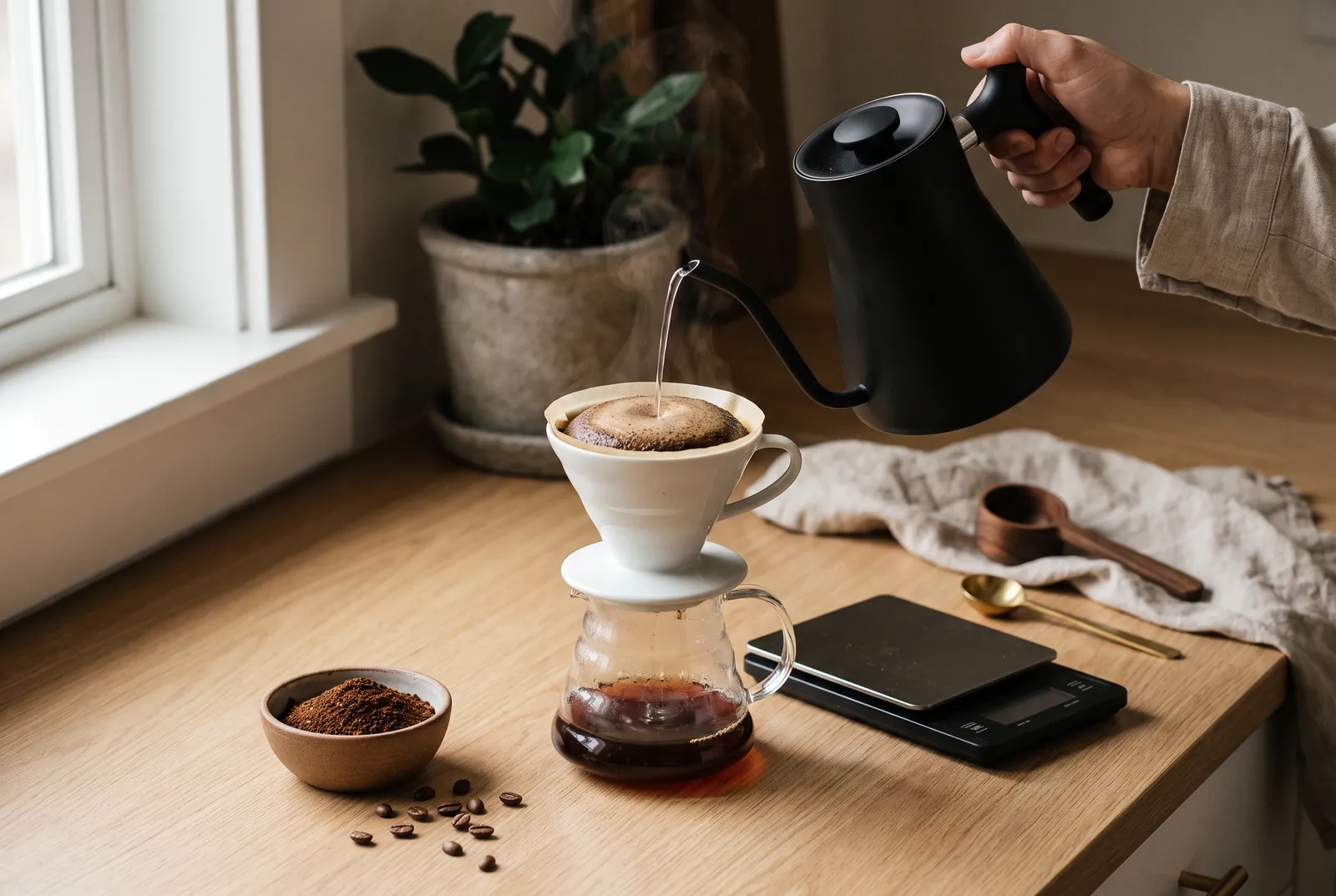
The FDA puts a 12-ounce cup of regular brewed coffee at 113 to 247 milligrams [1]. That more-than-twofold spread comes from how much ground coffee goes into the pot, the beans themselves and how the coffee is brewed. Size is the easy multiplier to forget: a 16- or 20-ounce takeout cup scales everything up.
If you brew at home, the most reliable way to keep your intake consistent is to weigh your coffee. Caffeine tracks the amount of coffee you use far more closely than it tracks the roast name on the bag.
Espresso: strong per ounce, modest per shot
USDA data list restaurant-prepared espresso at 212 mg of caffeine per 100 grams, which works out to about 63 mg in a 1-ounce shot [3]. Ounce for ounce, that is several times the caffeine of drip coffee. But a single shot is small, so one shot usually has less caffeine than a mug of drip, and a latte or cappuccino made with a double shot lands around 126 mg by the same math. Milk adds none.
Real-world shots vary much more than a database average. When researchers at the University of Glasgow analyzed 20 commercial espressos, caffeine differed sixfold. The strongest single espresso held 322 mg, and three others exceeded 200 mg. The authors pointed to the amount of coffee used by each shop as the likely main driver and called for better labeling [5].
Tip: Ask how many shots are in your drink. A "small" latte at one shop can have a single shot, while another uses a double as standard.
Cold brew: it depends on the dilution
Cold brew has a reputation for being either gentle or rocket fuel. The truth is that it depends on the recipe. In a study at Thomas Jefferson University, researchers steeped coffee at a 1:10 ratio (35 g of coffee in 350 mL of water) at room temperature. Caffeine extraction approached a plateau after about 400 minutes, or roughly 6.7 hours. After 24 hours, concentrations ranged from 990 to 1,230 mg per liter depending on roast and grind. Hot coffee brewed in a French press at the same ratio landed at 840 to 970 mg per liter for the coarse grinds, so cold brew matched or exceeded hot brewing in caffeine [7].
To put that in a cup: at 1,230 mg per liter, an undiluted 8-ounce glass of that 1:10 brew would hold roughly 290 mg. Dilute it half and half with water or milk, as many people do with concentrates, and you are near 145 mg. That is why the label matters more than the method. A can of High Brew Nitro Cold Brew lists 200 mg [10].
Shop ready-to-drink options in cold brew and RTD and mix-at-home bottles in coffee concentrates.
Instant coffee
USDA lists regular instant coffee powder at 3,142 mg of caffeine per 100 grams. With the database's own serving weights, that is about 31 mg in a 1-gram teaspoon and about 63 mg in a 2-gram single-serve packet [4]. A cup made with one or two level teaspoons therefore lands below most drip coffee, but heaping spoons in a big mug close the gap quickly. Compare brands in our instant coffee category.
Matcha
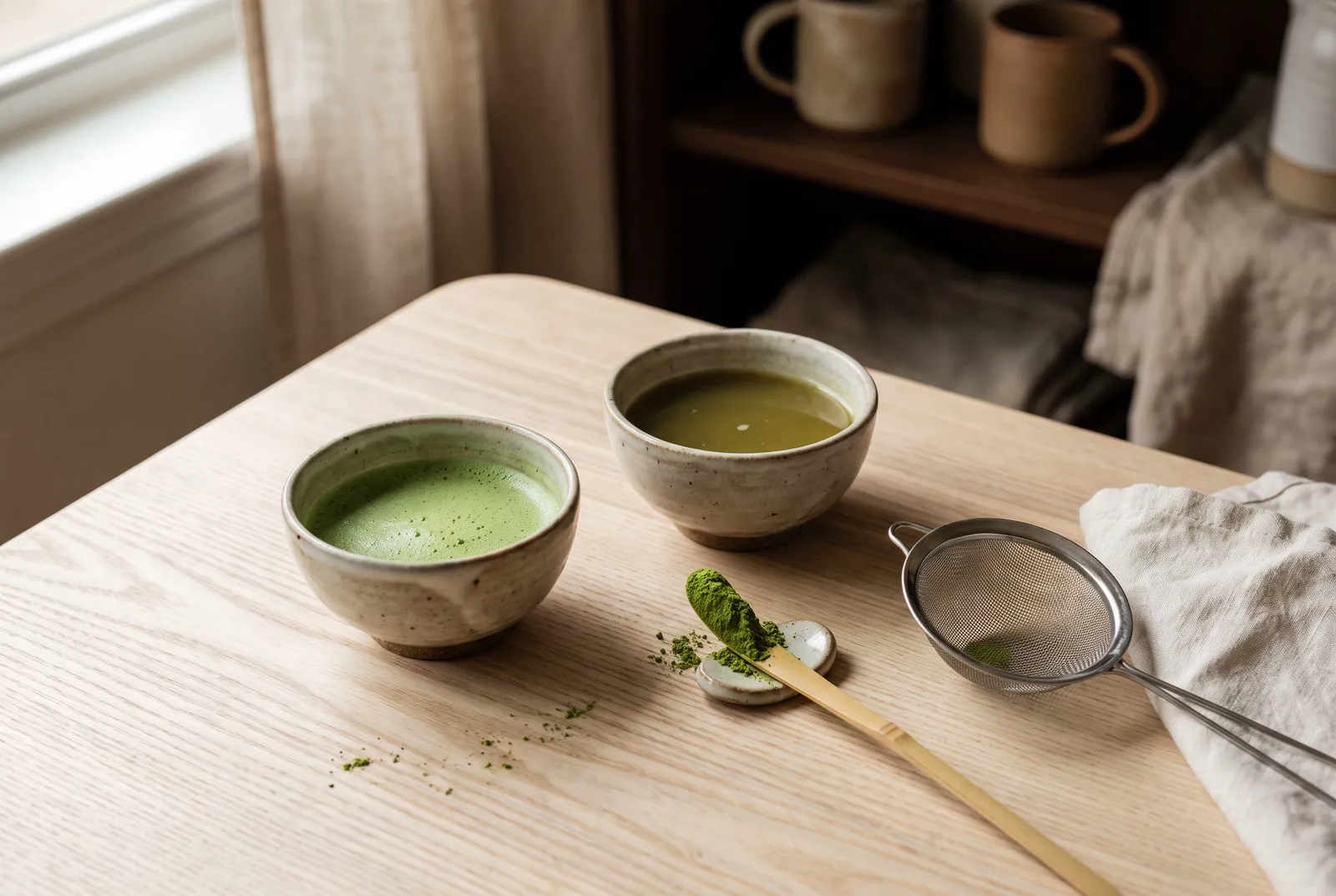
Because you drink the whole ground leaf, matcha carries more caffeine than most brewed green tea. A 2020 review in Molecules summarizes published measurements of 18.9 to 44.4 mg of caffeine per gram of matcha, compared with 11.3 to 24.67 mg per gram reported for green teas more broadly. Levels depend on harvest timing, leaf age, cultivar and growing conditions [8].
Most matcha brands in our matcha directory suggest about 2 grams per serving, which works out to roughly 38 to 89 mg. Lattes made with a heaping scoop can land higher. Matcha also contains L-theanine, an amino acid; one analysis cited in the same review found as much as 44.65 mg per gram in matcha samples [8]. For bottled and mix-based drinks, check the label in matcha lattes and drinks.
Canned and bottled coffee
Ready-to-drink coffee is one place where you can often read the exact number. La Colombe lists its 9-ounce Everyday Draft Latte at 100 mg of caffeine and notes that figure reflects a new, reduced caffeine level [9]. High Brew lists 200 mg per can of its Nitro Cold Brew [10]. For comparison, the FDA cites 41 to 246 mg per 12 ounces for energy drinks [1]. If a can does not list caffeine, check the brand's website before you drink two.
Decaf is not zero
Decaffeination removes most caffeine, not all of it. The FDA says decaf coffee typically has 2 to 15 mg in an 8-ounce cup [1]. A University of Florida study measured 0 to 13.9 mg per 16-ounce serving across 10 decaf coffees from different shops. At a single Starbucks outlet, decaf espresso ranged from 3.0 to 15.8 mg per shot, and brewed decaf from 12.0 to 13.4 mg per 16 ounces [6]. The authors noted that people who must restrict caffeine, including some patients on medications that interact with it, should know decaf can still contain caffeine [6].
At the high end of that study's range, five single-shot decaf lattes would add up to about 80 mg. That is small next to a regular coffee habit, but it is not nothing.
How much is too much?
For most healthy adults, the FDA cites 400 mg a day as an amount not generally associated with negative effects, which it equates to about two to three 12-ounce cups of coffee. Sensitivity varies widely from person to person. Signs you have overdone it include insomnia, jitters, anxiety, a fast heart rate, an upset stomach, nausea and headache. The FDA estimates that toxic effects such as seizures can occur with rapid consumption of around 1,200 mg, and notes that medical experts advise against energy drinks for children and teens [1].
Pregnancy calls for a lower ceiling. The American College of Obstetricians and Gynecologists, in a committee opinion reaffirmed in 2026, concludes that keeping caffeine under 200 mg a day does not appear to be a major factor in miscarriage or preterm birth, while any link to fetal growth restriction is still unsettled [2]. The FDA recommends that anyone pregnant, trying to become pregnant or breastfeeding talk with a health care provider about caffeine [1].
| Daily amount | Roughly equals |
|---|---|
| About 200 mg (ACOG advises staying under this in pregnancy [2]) | One can of High Brew Nitro Cold Brew [10], or two La Colombe Draft Lattes [9], or three single espresso shots at about 63 mg each [3] |
| About 400 mg (FDA's adult guidance [1]) | Two to three 12-ounce drip coffees [1], or six single espresso shots [3] |
Remember that coffee is not the only source. Tea, soda, energy drinks and some supplements count toward the same daily total.
Bottom line: Count milligrams, not cups. A big drip coffee can carry more caffeine than a double espresso, cold brew depends on dilution, matcha sits in the middle, and decaf still has a little. Most healthy adults can stay under 400 mg a day; during pregnancy, keep it under 200 mg and talk with your clinician.
This article is for general information and is not medical advice. If you have a heart condition, anxiety, take medications that interact with caffeine or have other health concerns, ask your doctor what is right for you. For more on how we evaluate products, see how we score or explore the directory.
FAQ
Does espresso have more caffeine than drip coffee?
Per ounce, yes, by a wide margin. Per drink, usually not. USDA data put a 1-ounce shot at about 63 milligrams, while the FDA puts a 12-ounce cup of brewed coffee at 113 to 247 milligrams. A double-shot latte lands around 126 milligrams by the same USDA math, but cafe shots vary: one study of 20 espressos found a sixfold range.
Is cold brew stronger than regular coffee?
It depends on the recipe. In one lab study, cold brew made at a 1:10 ratio reached caffeine levels similar to or higher than hot coffee made at the same ratio, because extraction keeps going over many hours. Most cold brew is brewed as a concentrate and diluted, so the cup you drink can be stronger or weaker than drip. Check the label on canned versions.
How much caffeine is safe during pregnancy?
The American College of Obstetricians and Gynecologists says keeping caffeine under 200 milligrams a day does not appear to be a major factor in miscarriage or preterm birth. That is about three single espresso shots, or one 12-ounce drip coffee at the lower end of its range. The FDA recommends that anyone pregnant, trying to conceive or breastfeeding talk with a health care provider about their own limit.
How much caffeine is in decaf coffee?
Some, but not much. The FDA says an 8-ounce cup of decaf typically has 2 to 15 milligrams. A University of Florida study measured 0 to 13.9 milligrams in 16-ounce decaf coffees from different shops and up to 15.8 milligrams in a single decaf espresso shot. That matters if you drink several cups a day or need to avoid caffeine for medical reasons.
References
- [1]Spilling the Beans: How Much Caffeine is Too Much? — U.S. Food and Drug Administration
- [2]Moderate Caffeine Consumption During Pregnancy (Committee Opinion No. 462) — American College of Obstetricians and Gynecologists
- [3]Beverages, coffee, brewed, espresso, restaurant-prepared — USDA FoodData Central (SR Legacy)
- [4]Beverages, coffee, instant, regular, powder — USDA FoodData Central (SR Legacy)
- [5]Espresso coffees, caffeine and chlorogenic acid intake: potential health implications — Food & Function, via PubMed
- [6]Caffeine content of decaffeinated coffee — Journal of Analytical Toxicology, via PubMed
- [7]The Effect of Time, Roasting Temperature, and Grind Size on Caffeine and Chlorogenic Acid Concentrations in Cold Brew Coffee — Scientific Reports, via PubMed Central
- [8]Health Benefits and Chemical Composition of Matcha Green Tea: A Review — Molecules (MDPI), via PubMed Central
- [9]Everyday Draft Latte — La Colombe Coffee Roasters
- [10]Nitro Cold Brew — High Brew Coffee
Discussion
What do you think?
No discussions yet.
Own this article? Ask a question or share your recipe — you’ll be the first.