Espresso machines are sold on numbers that sound decisive: 15 bar, 20 bar, 3-second heat-up, dual boilers. Some of those numbers matter a lot. Others are mostly marketing. And the most important variable often isn't the machine at all, but the grinder next to it. Here's how to choose, in the order the decisions actually matter.
Step 1: Decide how much control you want
| Type | How it works | Learning curve | Best for |
|---|---|---|---|
| Manual lever | You generate pressure by hand, often watching a gauge | Steep | Tinkerers and small spaces; straight espresso |
| Semi-automatic | A pump supplies pressure; you grind, dose, tamp and start and stop the shot | Moderate | Most home baristas; milk drinks |
| Super-automatic | Grinds, doses, tamps, brews and often froths milk with one button | Low | Busy households; variety at a press |
| Pod | Sealed capsules, little or no adjustment | None | Pure convenience |
Manual lever. The Flair 58 Plus 2 is a good example of the modern lever. You apply force with the lever while watching a built-in pressure gauge, and an electric preheat controller offers 85, 90 and 95 °C settings [5]. A newer wave of cranked and geared designs uses gear ratios to turn modest hand force into steady piston pressure, so you can shape pressure in real time without a motorized pump [10].
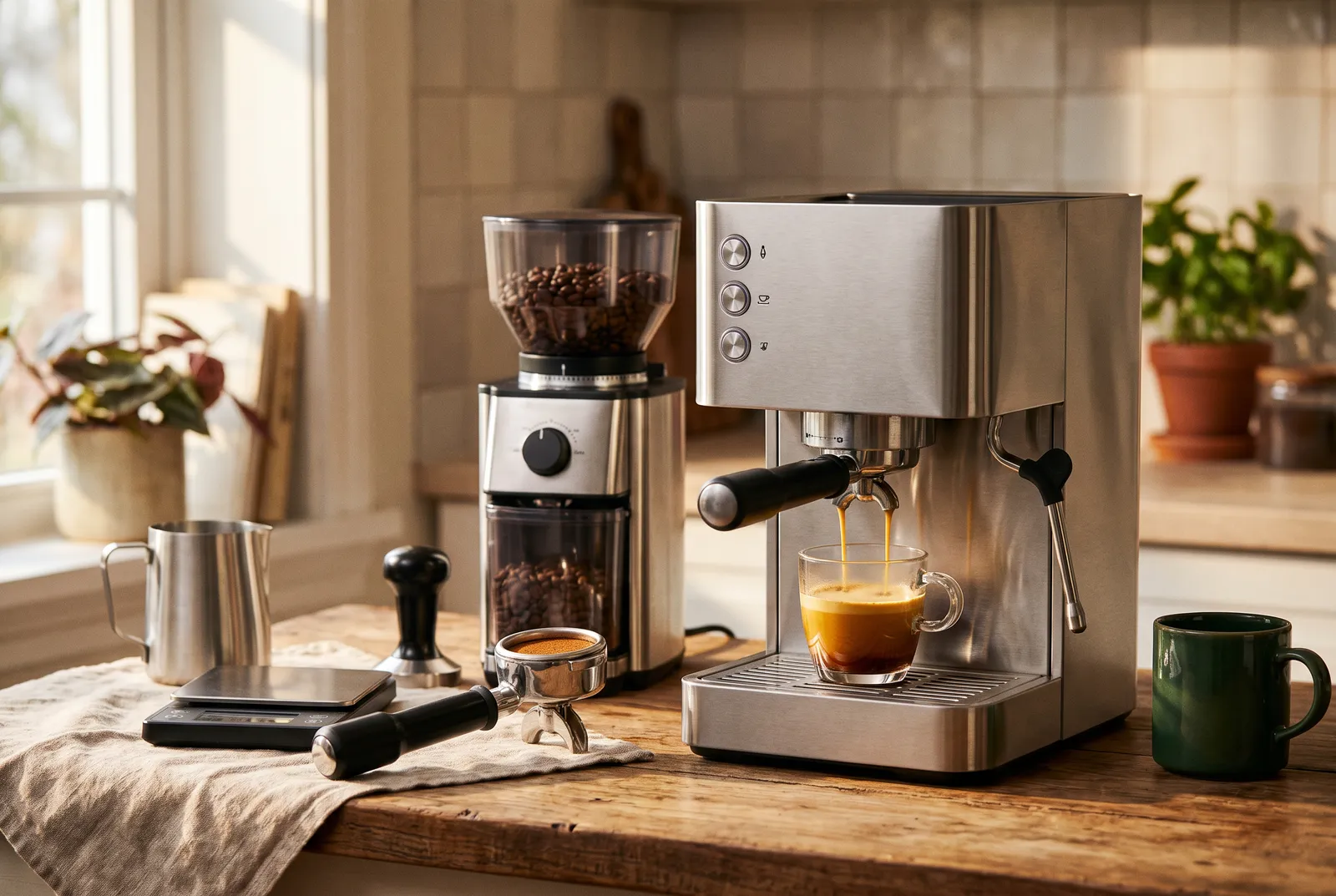
Semi-automatic. This is the classic home machine. You control everything from grind to shot length, and the machine handles pressure and temperature. Examples range from the single-boiler Gaggia Classic Pro [3] to Breville's Bambino Plus, which adds automatic milk texturing [2], and the Barista Express, which builds in a grinder [1].
Super-automatic. Bean-to-cup machines such as the Philips 3300 LatteGo grind, brew and froth milk on their own. That one uses a ceramic burr grinder with 12 settings and offers six drink options, including iced coffee [6]. The trade-off is limited control over grind, dose and shot ratio. You'll also have a brew unit and milk system to keep clean.
Pod. Capsule machines remove grinding, dosing and cleanup almost entirely. You also give up nearly all control, pay more per cup over time and create packaging waste. Compare formats in pods and capsules.
Tip: Be honest about mornings. If you won't weigh doses and adjust a grinder before work, a well-chosen super-automatic or pod machine will make you happier than an unused semi-automatic.
Step 2: Understand heating systems
Heating design decides how quickly you can start, whether you can steam milk while brewing, and how stable your brew temperature is.
Flash heaters: thermoblock, thermocoil and ThermoJet
These heat water on demand as it passes through a heated block or coil. They're fast and compact. Breville says the Bambino Plus's ThermoJet reaches extraction temperature in 3 seconds [2]. The Barista Express uses a thermocoil with PID control to deliver 200 °F water [1]. Steam power and back-to-back consistency vary by model, and most can't brew and steam at the same time.
Single boiler
One boiler handles both brewing and steaming at different temperatures, so you brew first, then wait for the boiler to heat up for steam. The Gaggia Classic Pro uses a single 3.5-ounce brass boiler [3]. It's an excellent espresso setup with a slower milk workflow.
Heat exchanger (HX)
One large boiler stays at steam temperature, and brew water passes through an isolated section that keeps it cooler, so you can brew and steam at once. Whole Latte Love notes that HX machines regulated by a pressurestat can swing by five to ten degrees at idle and often need a cooling flush before a shot, while PID control holds within about a degree [7]. Many HX machines use the E61 group, which can need 20 minutes or more to fully warm up [7].
Dual boiler
Separate brew and steam boilers give you simultaneous brewing and steaming and the most stable brew temperature. Many models also let you switch off the steam boiler on espresso-only days. They typically pair PID control with quieter rotary pumps [7]. They're also the biggest, heaviest and most expensive option.
PID
A PID is a digital temperature controller that keeps the heater tightly on target. It's far more accurate than a pressurestat [7], and on any machine type it's one of the most useful features you can pay for.
| Heating | Warm-up | Brew and steam at once | Temperature stability |
|---|---|---|---|
| Flash heater (with PID) | Seconds [2] | Usually not | Good for single drinks |
| Single boiler | Minutes | No | Good with PID |
| Heat exchanger | Often 20+ minutes with E61 [7] | Yes | Pressurestat swings; better with PID [7] |
| Dual boiler | Minutes to 20+ | Yes | Best |
Step 3: Ignore the bar-count arms race
Espresso extracts at around 9 bar. Breville says so directly: its spec pages describe a 9-bar extraction delivered by a 15-bar pump [1][2]. Gaggia pairs a 15-bar pump with what it calls the 9-bar brew pressure needed for café-quality extraction [3]. Research setups brew at the same level, such as 9 bar in a 2024 study on grind fines [8]. In a 2023 study on a flow-controlled machine, measured pressure rose to about 9 bar at the finest grind setting [9].
So what is "15 bar" or "20 bar"? It's what the pump can produce, not what your coffee experiences. Budget machines such as the CASABREWS CM5418 advertise a 20-bar pump [4]. The actual pressure at the puck depends on how much resistance the coffee bed provides (grind, dose and tamp) and on over-pressure valves that cap it. Gaggia, for example, lists its valve calibrated to 9 bar [3].
What's worth paying attention to instead:
- Pressurized vs. single-wall baskets. Dual-wall, or pressurized, baskets create resistance through a tiny exit hole, which makes them forgiving with pre-ground or uneven coffee. Single-wall baskets let you actually dial in. Breville's Bambino Plus comes with both [2], and the CM5418 ships with dual-wall baskets [4].
- Pre-infusion. Many machines start with a low-pressure soak, meant to wet the puck evenly, before ramping to full pressure [1][2].
- Pump type. Vibratory pumps are common and ramp up gently. Rotary pumps are quieter, commercial-grade and often plumbable [7].
- Pressure control. Lever and geared machines let you vary pressure through the shot by hand [10].
Watch out: A bigger bar number on the box doesn't mean better espresso. If two machines differ mainly in pump rating, choose on temperature control, baskets, steam performance and serviceability.
Step 4: Pick a portafilter size you can live with
| Size | Typical machines | What it means |
|---|---|---|
| 51 mm | Many budget machines, such as the CM5418 [4] | Fewer basket and tamper upgrades |
| 54 mm | Breville Barista Express, Bambino Plus [1][2] | Large ecosystem of baskets and accessories |
| 58 mm | Gaggia Classic Pro, Flair 58, E61-style machines [3][5][10] | Commercial standard; widest choice of precision baskets, tampers and distribution tools |
Size alone doesn't make better coffee. But 58 mm gives you the most room to upgrade, and many baristas find the wider, shallower puck a little more forgiving. Browse tampers, baskets and tools in accessories.
Step 5: Budget for the grinder
Espresso is brewed through a tight bed of very fine coffee, so the grinder sets the resistance that everything else depends on.
- Fines control flow. A 2024 study at 9 bar found that adding more fine particles reduced the coffee bed's permeability, slowing flow and lengthening shots. The tasting panel preferred shots of around 30 seconds at 19–20% extraction, brewed 20 g in and 40 g out [8].
- Flow and ratio beat other settings. In a 2023 study of flow rate, grind and temperature, flow rate had the largest effect on what ended up in the cup, and finer grinds amplified it. Brew ratio mattered even more. Stopping the shot at 38 g instead of 40 g changed chlorogenic acid concentration about as much as halving the flow rate [9].
In practice, you need a grinder that can make small, repeatable steps at the fine end, plus a scale to measure dose and yield. Built-in grinders are convenient; the Barista Express offers 16 settings [1]. A dedicated espresso grinder with finer adjustment will improve almost any machine, and it can move with you when you upgrade. Compare options in grinders, and pick up a 0.1 g scale in kettles and scales.
Tip: If your budget is fixed, a modest machine with an excellent grinder will usually make better espresso than an excellent machine with a mediocre grinder.
Budget tiers
| Tier | What you get | Examples (brand list price, October 2026) | Trade-offs |
|---|---|---|---|
| Under $200 | Compact pump machine, pressurized baskets, 51 mm | CASABREWS CM5418, $118.99 [4] | Limited dialing-in; modest steam |
| About $500–$700 | PID, real baskets, 54 or 58 mm, or a quality lever | Bambino Plus $499.95 [2]; Gaggia Classic Pro $549 [3]; Barista Express with grinder $699.95 [1]; Flair 58 Plus 2 $699 [5] | Separate grinder needed except on the Barista Express |
| About $600–$900 | Entry super-automatic with milk system | Philips 3300 LatteGo, $599.99 sale ($899.99 regular) [6] | Less control over shot and grind |
| Prosumer | Heat exchanger or dual boiler, E61 groups, rotary pumps, plumbing options [7] | Varies widely | Size, warm-up time and price |
Prices change often, so check before you buy. See how we weigh performance, build, usability and value on how we score, and compare current picks in espresso machines.
A quick buying checklist
- Drinks. Mostly lattes for two or more people? Prioritize steam power or simultaneous brew and steam. Mostly straight espresso? A single boiler or lever is enough.
- Time. How long will you wait each morning? Flash heaters take seconds [2]; E61 machines can take 20 minutes or more [7].
- Temperature control. Look for PID.
- Portafilter. 54 or 58 mm if you plan to upgrade baskets and tools.
- Grinder. Budget for it now, or choose a machine with a built-in grinder knowing its limits.
- Water and upkeep. Scale is the enemy. Use filtered or appropriately soft water and follow descaling guidance. Some super-automatics use filters to stretch descaling intervals [6].
- Service. Favor brands with available parts and repair support.
Bottom line: Choose the machine type that fits your routine, look for PID and a sensible portafilter, ignore bar-count marketing, and put real money into the grinder. That combination makes great espresso at every budget.
FAQ
Is a 20-bar espresso machine better than a 15-bar one?
No. Those numbers describe what the pump can produce, not the pressure your coffee sees. Machines from Breville and Gaggia pair 15-bar pumps with roughly 9-bar extraction, and research setups brew at about 9 bar too. Resistance from the coffee puck and the machine's valves set the real pressure. Compare temperature control, baskets and steam power instead.
Do I need a dual boiler?
Only if you regularly make several milk drinks in a row and want to brew and steam at the same time with very stable temperatures. For mostly straight espresso, or one or two lattes a day, a PID-controlled single boiler or fast flash-heater machine is plenty, and costs, weighs and warms up far less. Spend the difference on a better grinder.
Should I buy a machine with a built-in grinder?
It saves counter space and money up front, and it's a sensible way to start. The trade-offs are fewer grind settings, no way to upgrade the grinder separately, and losing both functions if one fails. If you already know you'll get serious about espresso, a separate espresso grinder with fine adjustment will outlast several machines.
Are pressurized baskets bad?
Not bad, just limiting. Dual-wall pressurized baskets force coffee through a tiny opening, which builds resistance even with pre-ground or uneven coffee. That makes them forgiving for beginners but caps flavor and texture. Once you have a grinder that can make fine, consistent adjustments, switch to single-wall baskets to dial in properly.
References
- [1]Barista Express - All In One Espresso Machine — Breville (US)
- [2]Bambino Plus - Small Home Espresso Machine — Breville (US)
- [3]Gaggia Classic Pro E24 — Gaggia North America
- [4]CM5418 Best-Selling Espresso Machine — CASABREWS
- [5]Flair 58 Plus 2 58mm Lever Espresso Machine — Flair Espresso
- [6]Philips 3300 Series Fully Automatic Espresso Machine - LatteGo — Philips
- [7]How to Choose a Prosumer Espresso Machine: Dual Boiler or Heat Exchange? — Whole Latte Love
- [8]The role of fines in espresso extraction dynamics — Scientific Reports (2024), via PubMed Central
- [9]Influence of Flow Rate, Particle Size, and Temperature on Espresso Extraction Kinetics — Foods (2023), via PubMed Central
- [10]The Screwy New World of Cranked and Geared Espresso — Daily Coffee News by Roast Magazine
Discussion
What do you think?
No discussions yet.
Own this article? Ask a question or share your recipe — you’ll be the first.