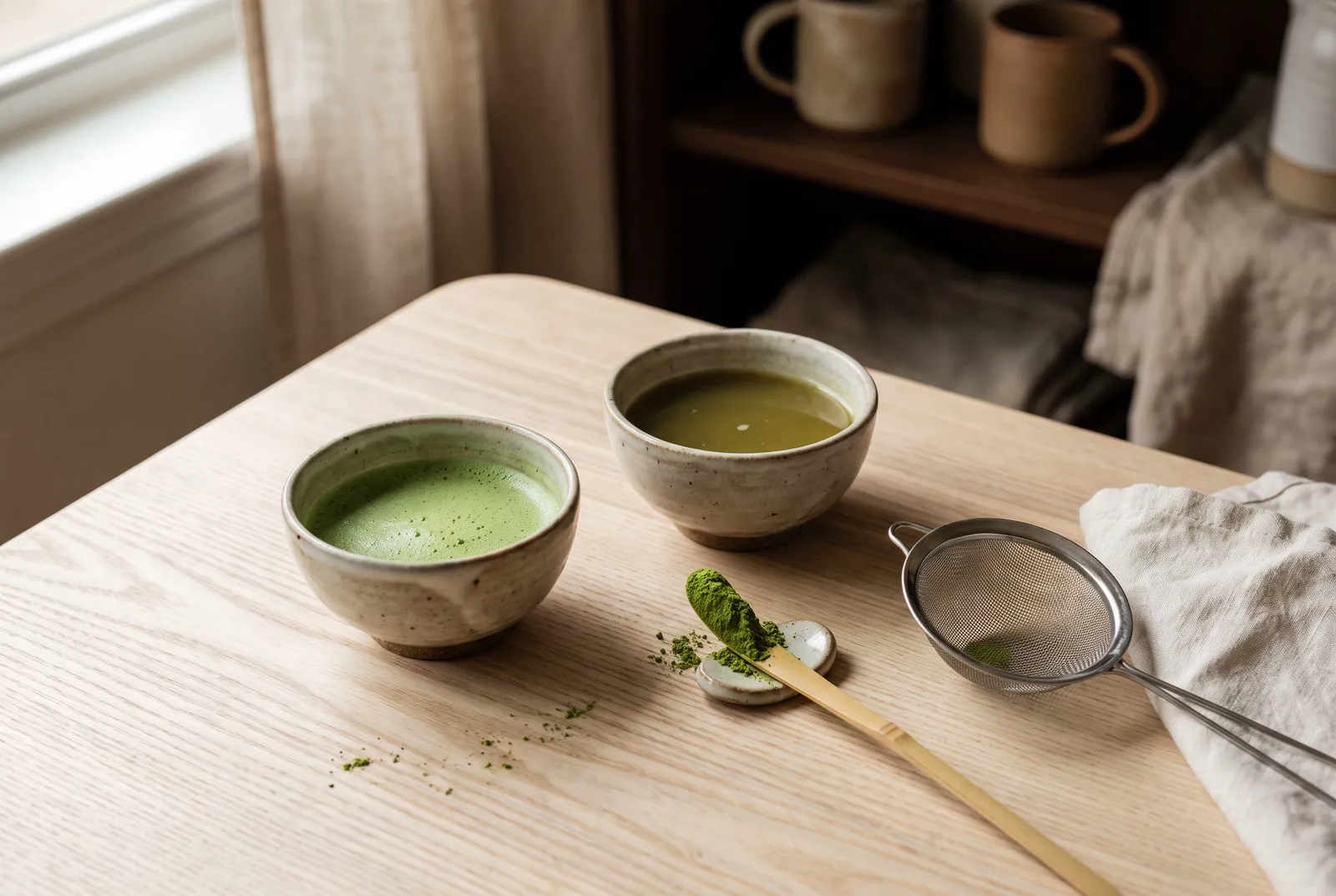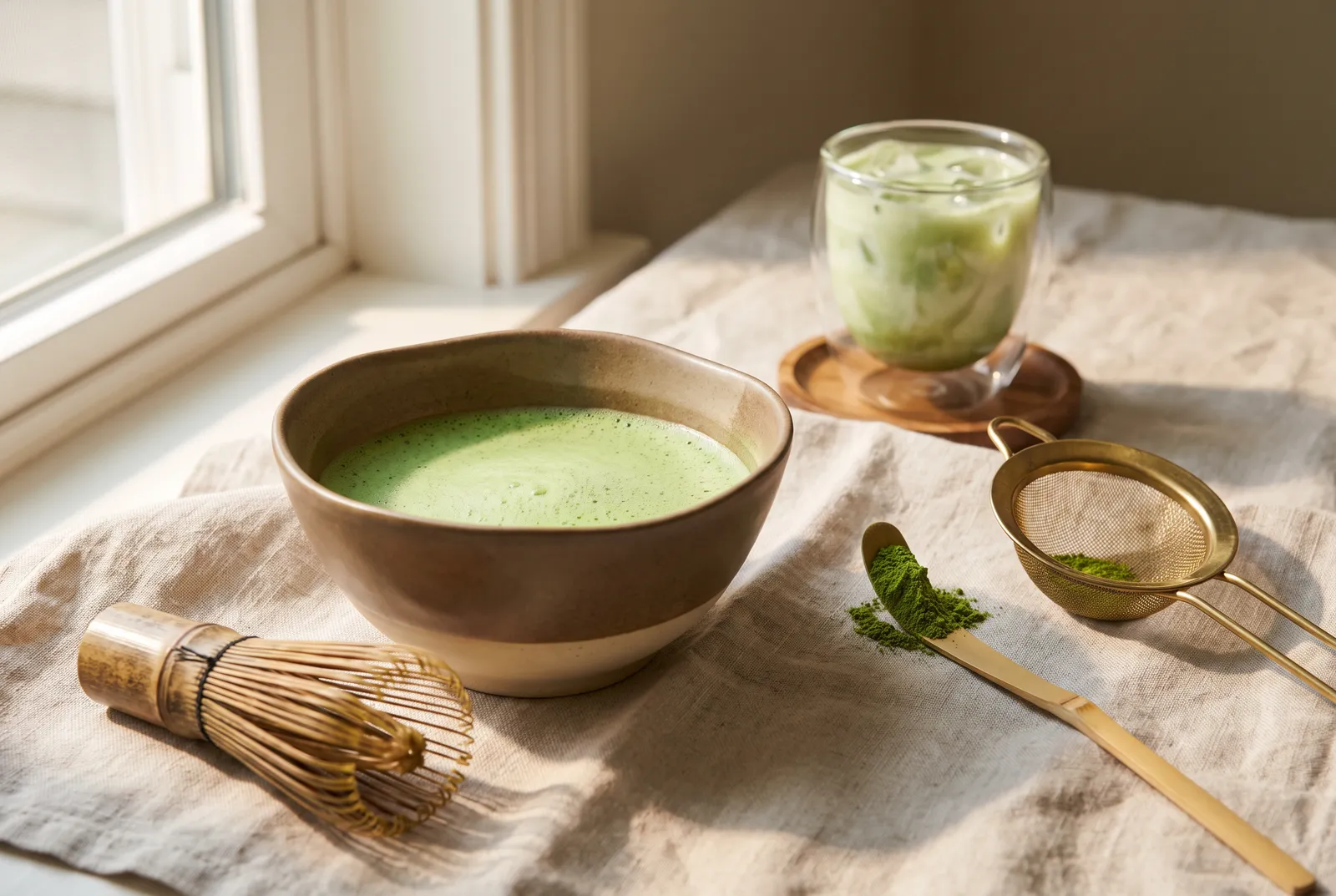
Good matcha isn't hard to make, but it is unforgiving. A few grams of powder, a little hot water and 15 seconds of whisking separate a sweet, velvety bowl from a bitter, gritty one. The good news is that most problems trace back to three things: lumps, water that's too hot and a lazy whisk. Here's a method that fixes all three, plus lattes, iced versions and the tools you can skip.
What you need (and what you can skip)
The traditional kit is a bamboo whisk (chasen), a bamboo scoop (chashaku) and a wide bowl (chawan). Only the whisk really changes the result, and even that has decent stand-ins.
| Tool | What it does | Good alternative |
|---|---|---|
| Chasen (bamboo whisk) | Disperses powder and builds fine foam | Handheld milk frother; small balloon whisk (coarser foam); a sealed bottle for iced matcha [7] |
| Chashaku (bamboo scoop) | Portions powder | A level teaspoon is about 2 g [1]; a 0.1 g scale is better |
| Chawan (tea bowl) | Gives the whisk room to move | Any wide, flat-bottomed bowl, such as a cereal bowl. Mugs are cramped |
| Sieve | Breaks up clumps | Any fine tea strainer or small mesh sieve |
| Kettle | Controls temperature | Boil and cool, or pour between vessels (see below) |
If you're shopping, compare whisks, sifters and frothers in accessories, and kettles and scales in kettles and scales.
Tip: Soak the whisk's tines in warm water for a minute before using it. Dry bamboo is brittle, and softened tines spring back instead of snapping.
The usucha method, step by step
Usucha ("thin tea") is the everyday frothy bowl. Respected sources agree on the outline and differ on the numbers. Ippodo uses 2 g of matcha in 60 ml of water at 80 °C [1]. The World Green Tea Association suggests two scoops in about 80 ml at 90 °C [3]. Our starting point sits in between.
Baseline: 2 g matcha · 70 ml water · 75–80 °C
- Warm the bowl. Pour in hot water, swirl, discard and wipe dry [3]. A warm bowl keeps the tea from cooling while you whisk.
- Sift the matcha. Push 2 g through a fine strainer into the bowl [1][3]. Matcha is ground very fine, roughly 1–20 micrometers in a stone mill [4], and particles that fine clump from static and humidity. Sifting is the single biggest upgrade you can make.
- Make a paste (optional). Add a splash of water and stir with the whisk until smooth. This guarantees no hidden lumps.
- Add the water. Pour in the rest, 60–80 ml total, at 70–80 °C.
- Whisk fast, from the wrist. Hold the bowl steady with one hand. Keep the whisk nearly upright, with the tines just touching or barely above the bottom. Move it quickly back and forth [3], tracing the M or W shape many teachers describe, not circles. Keep going for about 15 seconds, until the surface is covered in fine foam [1].
- Refine the foam. Slow down and lift the tines toward the surface to pop larger bubbles. Then draw the whisk out from the center in a small spiral [3].
- Drink it now. Matcha is a suspension, not a solution, and the powder starts settling within minutes.
Watch out: Circular stirring is the classic beginner mistake. It mixes the tea but doesn't aerate it, so you get a flat surface with a few big bubbles. Short, fast, side-to-side strokes make the foam.
Getting the water right
Temperature
Ippodo uses 80 °C for both thin and thick tea [1][2], while the World Green Tea Association goes as high as 90 °C for usucha [3]. In practice, cooler water reads sweeter and softer, and hotter water pushes bitterness and astringency forward. Lab work shows that temperature changes what dissolves. In one study of matcha infusions, total polyphenols and antioxidant readings were generally highest at 80–90 °C, while vitamin C was lower at 80–90 °C than at 25–70 °C [9]. For most people the choice comes down to taste. Start at 75–80 °C, then go cooler if it's harsh.
No thermometer? Use the method from Japan's official tea-brewing guide. Each pour from one vessel to another drops the temperature by roughly 5–10 °C. Boiling water poured into a pot lands near 90 °C, and pouring it again brings it near 80 °C [4].
Water quality
Japan's agriculture ministry recommends soft water, under 100 mg/L hardness and ideally about 30–80 mg/L, for Japanese tea. Hard water turns the tea pale and strips its fresh aroma [4]. If your tap water is very hard, filtered or bottled soft water makes a visible difference in matcha's green.
Thick tea (koicha), briefly
Koicha uses double the powder and half the water: 4 g sifted with 30 ml at 80 °C, whisked slowly for about 15 seconds into a glossy, pourable paste [2]. Skip the fast foam-building strokes. The goal is a smooth, even texture. Use your sweetest, freshest matcha here, because any bitterness becomes obvious at this concentration. Compare high-grade powders in our matcha category.
Matcha lattes
The secret to a smooth latte is to whisk the matcha with water before any milk touches it. Ippodo's method is 3 g of sifted matcha whisked with 90 ml of water at 80 °C, with milk or soy milk added to taste [5]. For a café-style drink with less water and more milk, try this:
- Sift 2–3 g of matcha into a bowl or wide cup.
- Add 40–60 ml of water at about 80 °C and whisk into a smooth, foamy concentrate.
- Sweeten now if you like. Sugar, honey and syrups dissolve far better in the warm concentrate than in milk.
- Add 150–200 ml of steamed or frothed milk. Oat and soy milks with a "barista" formulation foam most like dairy.
Tip: Lattes are where a bolder, cheaper matcha shines. Milk mutes delicate sweetness, so save your best tin for straight usucha. Ready-made mixes are in matcha drinks.
Iced matcha, three ways
- Whisk hot, then chill. Whisk 2 g with 60 ml of water at 80 °C, then pour over ice [6]. You get full aroma and a quick chill.
- Cold-whisk. Whisk 2 g with 60 ml of chilled water for about 15 seconds. Ippodo notes that cold water brings out matcha's sweetness [8]. Sift carefully, because cold water clumps more.
- Shake it. Sift 1 g into a travel bottle, add 100 ml of ice water, seal and shake [7]. This is the easiest office or travel option, and it's lighter by design.
For an iced latte, whisk the concentrate from the latte recipe, pour cold milk over a full glass of ice and float the matcha on top.
Recipe ratios at a glance
| Drink | Matcha | Liquid | Water temp | Method |
|---|---|---|---|---|
| Usucha (thin) | 2 g | 60–80 ml water | 70–90 °C | Fast M/W whisk, about 15 s [1][3] |
| Koicha (thick) | 4 g | 30 ml water | 80 °C | Slow, even whisk [2] |
| Hot latte | 2–3 g | 40–90 ml water, then milk to taste | About 80 °C | Whisk concentrate, add milk [5] |
| Iced, whisked hot | 2 g | 60 ml water, then ice | 80 °C | Whisk, pour over ice [6] |
| Iced, cold-whisked | 2 g | 60 ml chilled water | Cold | Vigorous whisk [8] |
| Shaken | 1 g | 100 ml ice water | Cold | Shake in a sealed bottle [7] |
Which matcha for which drink
Matching the powder to the drink saves money and improves the cup.
- Straight usucha: a fresh, bright, sweet matcha. This is where quality shows, so it's worth paying for.
- Koicha: only your sweetest, richest tin. Bitterness concentrates at double strength [2].
- Lattes: a bolder, more economical grade. Milk softens astringency and mutes delicate aromas.
- Iced and cold-whisked: a mid-range powder works well, because cold water brings sweetness forward [8].
- Baking and smoothies: the least expensive powder that's still labeled matcha, not "green tea powder."
Dial it in: a one-week practice plan
Matcha rewards small, deliberate changes. Change one variable per day and taste side by side when you can.
- Day 1: Make the baseline (2 g, 70 ml, 75–80 °C) and note sweetness, bitterness and foam.
- Day 2: Same recipe at 70 °C. Did it get sweeter or just weaker?
- Day 3: Return to your preferred temperature and try 60 ml, then 80 ml.
- Day 4: Focus on technique. Whisk faster and finish nearer the surface.
- Day 5: Try it cold-whisked [8] and compare the sweetness.
- Days 6–7: Lock in your recipe, write it on the tin, and use it as your reference when you open a new matcha.
Most people end up within a few degrees and a few milliliters of the baseline. The point is to know why you like it that way.
Troubleshooting
| Problem | Likely cause | Fix |
|---|---|---|
| Lumps or grit at the bottom | Skipped sifting; water added too fast | Sift every time; make a paste first |
| Big bubbles, no fine foam | Circular stirring; slow strokes; too much water | Faster wrist strokes; finish near the surface |
| Bitter or harsh | Water too hot; too much powder; stale or culinary grade | Drop to 70–75 °C; use slightly less powder; buy fresher |
| Dull color, flat aroma | Old matcha; hard water | Fresher tin; softer water [4] |
| Weak, milky latte | Too much milk for the dose | Add 1 g more matcha or cut the milk |
| Whisk tines snapping | Dry, brittle bamboo | Pre-soak; dry upright on a holder |
Caring for tools and powder
Rinse the chasen in warm water after each use, with no soap, and let it dry upright, ideally on a whisk holder so the tines keep their shape. Replace it when tines start breaking off. Keep matcha sealed, cool and dark, and finish an opened tin within a few weeks. If you store it in the fridge, let the closed tin come to room temperature before opening so condensation doesn't form on the powder. To get better at describing what you taste, from seaweed-sweet to grassy and bitter, practice with the flavor wheel.
Bottom line: Sift, use water around 75–80 °C, and whisk fast from the wrist. Get those three right and an ordinary tin of matcha tastes far better. A great tin will show you why people fall for it.
FAQ
Can I make matcha without a bamboo whisk?
Yes. A battery-powered milk frother disperses powder quickly and builds decent foam, especially for lattes. A sealed bottle or jar works for iced matcha: add sifted powder and cold water, then shake hard. A small balloon whisk works in a pinch but makes coarser bubbles. A chasen still makes the finest, creamiest foam for straight usucha.
What water temperature is best for matcha?
Most guidance falls between 70 and 90 °C. Ippodo uses 80 °C for usucha and koicha, and the World Green Tea Association suggests 90 °C for usucha. Cooler water usually tastes sweeter and less bitter, while hotter water brings out astringency. Start around 75 to 80 °C, then adjust to your matcha and your palate.
Why is my matcha bitter?
The usual causes are water that's too hot, too much powder for the water, stale matcha, or a grade meant for cooking. Try cooler water, around 70 to 75 °C, and drop the dose slightly. Make sure the tin is fresh and bright green. If it's still harsh, use that powder for lattes and buy a sweeter grade for straight tea.
How long does matcha stay fresh after opening?
Treat it like ground coffee: it fades fast. Keep the tin tightly sealed, cool and dark, and plan to finish it within a few weeks. If you refrigerate it, let the closed tin warm to room temperature before opening so moisture doesn't condense on the powder. Dull color and a flat, hay-like smell mean it's past its best.
References
- [1]Basic Usucha (Matcha) — Ippodo Tea
- [2]Basic Koicha (Matcha) — Ippodo Tea
- [3]How to prepare Japanese tea: Usucha (Light Matcha) — World Green Tea Association (O-CHA NET)
- [4]The proper way to brew Nihoncha — Ministry of Agriculture, Forestry and Fisheries of Japan
- [5]Matcha Latte — Ippodo Tea
- [6]Matcha Over Ice — Ippodo Tea
- [7]Shaken Matcha — Ippodo Tea
- [8]Cold-whisked Matcha — Ippodo Tea
- [9]Antioxidant Properties and Nutritional Composition of Matcha Green Tea — Foods (MDPI), via PubMed Central
Discussion
What do you think?
No discussions yet.
Own this article? Ask a question or share your recipe — you’ll be the first.