Few decisions shape a cup of coffee as much as the roast. SCA's science column points to a UC Davis study in which roast level had the largest effect on sensory attributes of the six variables tested, and to a 2020 study that found roast color predicted flavor better than roast time [1]. Shoppers seem to know it: across independent consumer studies, roast level ranks as the most important information on a specialty coffee label [2].
The vocabulary, though, is a mess, and a couple of myths refuse to die. Here is what actually changes as a bean goes from tan to near-black, and how to use that at the store and at home.
What happens inside the roaster
Green coffee is a woody seed with little obvious flavor. Roasting creates nearly everything you taste [1]. Most roasts run at 180 to 240 °C for roughly 5 to 15 minutes [4], and SCA notes that beans can be heated as high as 250 °C [1]. Along the way, the chemistry moves through a few overlapping stages.
- Drying. Water evaporates, the bean loses mass, and its color shifts from green toward yellow [4].
- Browning. Starting at around 160 °C, Maillard reactions join reducing sugars with amino groups [4], producing compounds that are brown and aromatic [1]. Some intermediates link into melanoidins, the dark compounds behind malty, nutty flavors and a sense of weight in the mouth. Bread crust and beer get flavor and color from the same family [1][4].
- Caramelization and first crack. Sucrose breaks down into glucose and fructose [4]. Pressure from steam and gases builds until the bean cracks audibly, usually somewhere between about 170 and 200 °C [4].
- Development and second crack. After first crack, the roaster decides how far to go. A second crack signals that the roast is almost finished [4]; beans taken that far are firmly in dark-roast territory.
The bean also changes physically. It loses water and mass and puffs up from the inside. In a 2024 study of two Ethiopian coffees, internal porosity climbed from 13.6% in the green bean to 45.8% at the darkest roast tested [6]. Keep that number in mind; it matters for the caffeine question below.
Roasting burns off weight, too. In the same study, the two lightest batches of the washed coffee lost 8.9% and 11.6% of their mass, and the washed coffee consistently lost 2 to 3 percentage points less than the natural-process coffee at the same roast designation [6]. Two bags that both say "medium" can sit at noticeably different points on the curve.
A field guide to roast levels
| Light | Medium | Dark | |
|---|---|---|---|
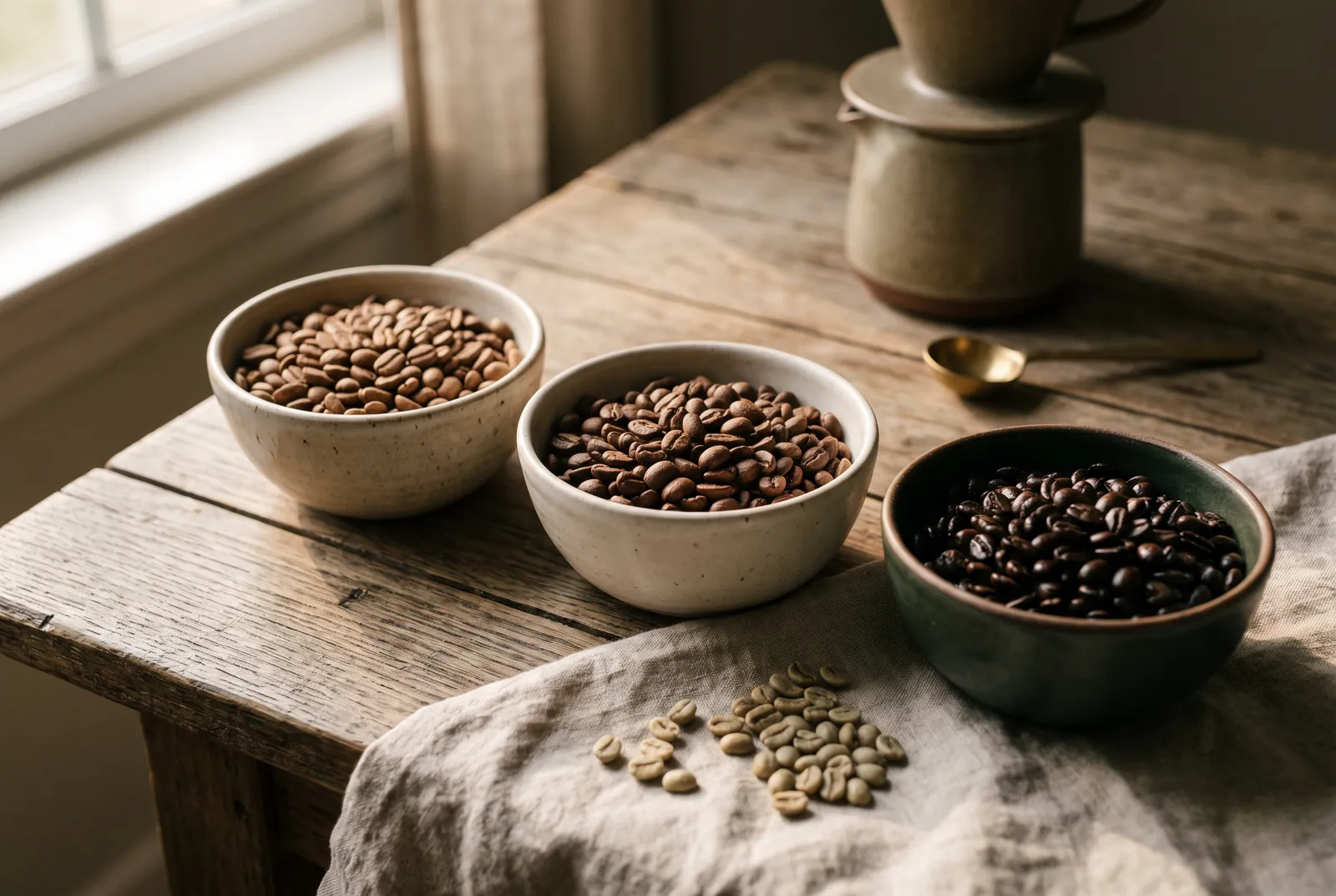
| Bean color and surface | Light brown, matte; oils stay inside [3] | Medium brown, non-oily [3] | Shiny, black, oily [3] |
| Roasted flavor | Subtle [3] | Stronger [3] | Pronounced bitterness [3] |
| Typical tasting notes | Fruity, floral [2] | Between the two | Chocolatey, bittersweet [2] |
| Acidity | Highest [3] | Moderate | Lowest [3] |
| Body | Lighter | Medium | Heavier, from more melanoidins [1] |
| Names you may see | Blonde, Cinnamon | American, breakfast blend [3] | French, Italian [3] |
The National Coffee Association lists the popular names in order from light to dark: Blonde or Cinnamon, City, Full City, Vienna, French and Italian [3]. Treat the middle of that list loosely; more on that below.
Acidity: where the brightness goes
"The lighter the roast, the more acidic your brewed coffee will be," as the NCA puts it [3]. Much of that comes down to chlorogenic acids, a family of compounds abundant in green coffee that roasting steadily destroys. A UC Davis team measured 34 to 42 mg per gram of total chlorogenic acids in commercial green beans against just 2 to 7 mg per gram in roasted ones. When the researchers roasted beans themselves, 12 minutes at 230 °C cut the total to roughly half, and 21 minutes at 250 °C reduced it to almost trace levels. They also found a general correlation between these acids and the brew's pH [5].
In the cupping room, "acidity" is a compliment. It describes a lively, juicy brightness, the quality that makes a light-roast Kenyan taste like blackcurrant rather than toast. If you dislike that sensation, you are not doing anything wrong; you probably prefer medium or darker roasts.
Bitterness, sweetness and body
Roasting is one of the most significant sources of bitterness in coffee. Browning reactions create bitter compounds, and SCA calls controlling the roast the easiest way to manage a coffee's bitterness [9]. Brew strength stacks on top of that: coffees with higher total dissolved solids tend to taste more bitter [9].
UC Davis research on drip coffee adds a useful wrinkle. Across light, medium and dark roasts, perceived sweetness fell as brew strength rose, regardless of roast; in the medium roast, dark chocolate and blueberry notes faded as strength increased, too [10]. If a dark roast tastes harsh, try brewing it a little weaker before you write it off.
Body moves the other way. Darker color generally means more melanoidins, and melanoidins add heaviness [1]. It is one reason a French roast can feel thicker on the tongue than a light Ethiopian, even at the same strength.
Caffeine: the myth, by weight and by scoop
The myth: dark roast tastes stronger, so it must contain more caffeine. The NCA's answer to whether dark roast is stronger is a flat no [3], and Harvard's Nutrition Source calls the idea a myth, noting that lighter roasts have a slightly higher concentration [8].
The research backs that up, with nuance:
| Study | How it was brewed | What it found |
|---|---|---|
| Lindsey et al., 2024 [6] | AeroPress, 10 g coffee to 150 g water | Caffeine peaked at roughly 14–16% roast mass loss and was lower at the darkest roasts; scaled to an 8-oz cup, all brews landed between 134 and 165 mg |
| Fuller and Rao, 2017 [7] | Cold brew, 1:10, 24 hours | Coarse-ground medium roast: 1,230 mg/L; coarse-ground dark roast: 990 mg/L |
| NCA and Harvard [3][8] | Consumer guidance | Dark roast is not higher in caffeine; light roasts are slightly higher |
The 2024 study attributes the late-roast decline to caffeine subliming once bean temperatures pass roughly 400 to 420 °F. Its authors also concluded that extraction yield, how much of the coffee you actually dissolve, played a bigger role in final caffeine than roast degree did [6]. In the cold brew study, the difference between roasts was significant for the coarse grind but not for the medium grind [7].
Now the scoop problem. Because darker beans have lost more mass and become far more porous [6], the same scoop holds fewer grams of dark roast than light roast. Measure by volume and the light roast pulls ahead simply because you used more coffee. Measure by weight and the gap mostly disappears.
Tip: Weigh your coffee. A scale removes the scoop bias, keeps strength consistent when you switch roasts, and makes caffeine comparisons meaningful.
Why dark roast tastes "strong"
When people call a coffee strong, they usually mean intensity of flavor, not caffeine. Dark roasts earn that reputation honestly: browning reactions add bitter compounds [9], melanoidins add weight [1], and the bright acids that make light roasts taste lively are largely gone [5]. Strength in the technical sense is something else: the concentration of dissolved coffee in your cup, which your brew ratio controls. A light roast brewed at 1:14 will usually be stronger, in that sense, than a dark roast brewed at 1:18, whatever the label says.
Brewing each roast well
Roast changes how coffee behaves in the brewer, not just how it tastes. In the 2024 AeroPress study, the darkest roasts produced the lowest extraction yields for both coffees. For the natural coffee, yields were highest at the lightest roast; for the washed coffee, they peaked at a medium roast, and the authors tie the slight dip in its lightest batches to lower porosity [6]. The takeaway: a roast level does not dictate your grind. Let the cup decide.
Adjustments we use as starting points:
- Light roasts: grind a step finer, brew with water at the hot end of your range, and give them time. A sour or thin cup is underextraction talking.
- Medium roasts: start with your standard recipe. They are the most forgiving.
- Dark roasts: if the cup turns harsh or ashy, brew slightly weaker before you grind coarser. Higher strength amplifies bitterness [9], and sweetness drops as strength rises [10]. Slightly cooler water can also take the edge off.
Which roast for which brew method
There are no rules here, only good starting points. These are ours.
| Brew method | Starting roast | Why |
|---|---|---|
| Pour-over | Light to medium | Clarity and acidity show off origin character |
| Automatic drip | Medium | Forgiving, balanced, easy to brew well at volume |
| Espresso, straight | Medium to light-medium | Sweetness and acidity without harshness at high strength |
| Espresso with milk | Medium to medium-dark | Chocolate and caramel notes carry through milk |
| French press and moka pot | Medium to dark | Full body and roasty sweetness suit heavy-bodied brews |
| Cold brew | Medium to dark | Chocolatey, low-acid profile; medium kept more caffeine in one study [7] |
A light-roast cold brew can be wonderfully fruity, and a dark-roast pour-over can be a cozy cup. Use the table to start, then follow your taste.
How to read roast descriptors
There is no industry-wide standard for roast names. SCA's science column warns that terms like "French," "Italian" and "Full City" may be too arcane or flexible to be meaningful, and experts at a San Diego conference debated whether to standardize them [2]. SCA has also been surveying the industry on whether formal roast color standards would help [1]. Until then, read the bag like a detective:
- Tasting notes. Fruit and flowers point to lighter roasts; chocolate, caramel and smoke point darker [2]. Our flavor wheel decodes the vocabulary.
- The bean surface. Visible oil means a dark roast; matte beans are light or medium [3].
- Blend names. "Breakfast blend" usually signals a medium roast [3]. "Espresso roast" describes an intended use more than a measured color.
- Color numbers. Some roasters print a reading from a roast color meter. On the widely used Agtron-style scales, higher numbers mean lighter roasts.
- The roast date. Freshness affects flavor at every roast level, so look for a date, not just a best-by.
Compare roast levels across our whole bean and ground coffee listings, or see how we score flavor and freshness.
Bottom line: Light roasts trade body for brightness and origin character; dark roasts trade acidity for roasty sweetness, bitterness and weight. Caffeine is roughly a wash, so choose the flavor you like, weigh your coffee, and treat roast names as hints rather than specifications.
FAQ
Does dark roast coffee have more caffeine than light roast?
No. Caffeine survives roasting fairly well, and studies find similar or slightly lower caffeine in the darkest roasts. A 2024 study saw caffeine in the cup peak partway through the roast range and decline at the darkest roasts. Bold, bitter flavor is not a sign of extra caffeine. If you scoop rather than weigh, a scoop of dark roast actually holds less coffee by weight.
Is light roast coffee more acidic?
In flavor terms, yes. Lighter roasts keep more chlorogenic acids, which roasting steadily breaks down, and the National Coffee Association notes that the lighter the roast, the more acidic the brewed coffee. Coffee professionals use acidity to describe a bright, juicy quality, which is part of why light roasts taste fruity. Darker roasts trade that brightness for roasty, bittersweet flavors and more body.
What do City and Full City roast mean?
They are traditional names on the roast spectrum. The National Coffee Association lists common names from light to dark as Blonde or Cinnamon, City, Full City, Vienna, French and Italian. There is no enforced standard, so one roaster's Full City can look like another's Vienna. Tasting notes on the bag and the bean surface, matte or oily, are more reliable clues.
Which roast is best for espresso?
Any roast can make good espresso, but medium to medium-dark roasts are the easiest starting point, especially for milk drinks, because their chocolate and caramel character cuts through milk. Light roasts can make vivid, fruity espresso, but they usually need a finer grind, a longer ratio and sometimes hotter water. Pick the flavor you enjoy, then dial in for that coffee.
References
- [1]Coffee Decoded: Flavor from the Fires–Why Roast Color Matters — Specialty Coffee Association
- [2]Coffee Decoded: Why is Roast Level so Important to Consumers? — Specialty Coffee Association
- [3]Roasts — National Coffee Association
- [4]Thermal Contaminants in Coffee Induced by Roasting: A Review — International Journal of Environmental Research and Public Health, via PubMed Central
- [5]Role of roasting conditions in the level of chlorogenic acid content in coffee beans: correlation with coffee acidity — Journal of Agricultural and Food Chemistry, via PubMed
- [6]Caffeine content in filter coffee brews as a function of degree of roast and extraction yield — Scientific Reports, via PubMed Central
- [7]The Effect of Time, Roasting Temperature, and Grind Size on Caffeine and Chlorogenic Acid Concentrations in Cold Brew Coffee — Scientific Reports, via PubMed Central
- [8]Coffee — The Nutrition Source, Harvard T.H. Chan School of Public Health
- [9]Coffee Decoded: What Makes Coffee Bitter? — Specialty Coffee Association
- [10]Brewing Fundamentals — Coffee Science Foundation and UC Davis Coffee Center
Discussion
What do you think?
No discussions yet.
Own this article? Ask a question or share your recipe — you’ll be the first.