Coffee is the seed of a fruit. Before anyone can roast it, someone on a farm or at a mill has to get the fruit off and dry the seed until it is stable enough to store and ship; the National Coffee Association describes drying to about 11% moisture [1]. How they do that is called processing, and it is one of the biggest flavor decisions made before the coffee ever leaves its origin.
Processing is not just a cleanup step. German researchers found that coffees processed by wet and dry methods still tasted different when the starting cherries were identical, which means the beans themselves were changing during processing [4]. Here is what each method involves and why the results taste the way they do.
Inside a coffee cherry
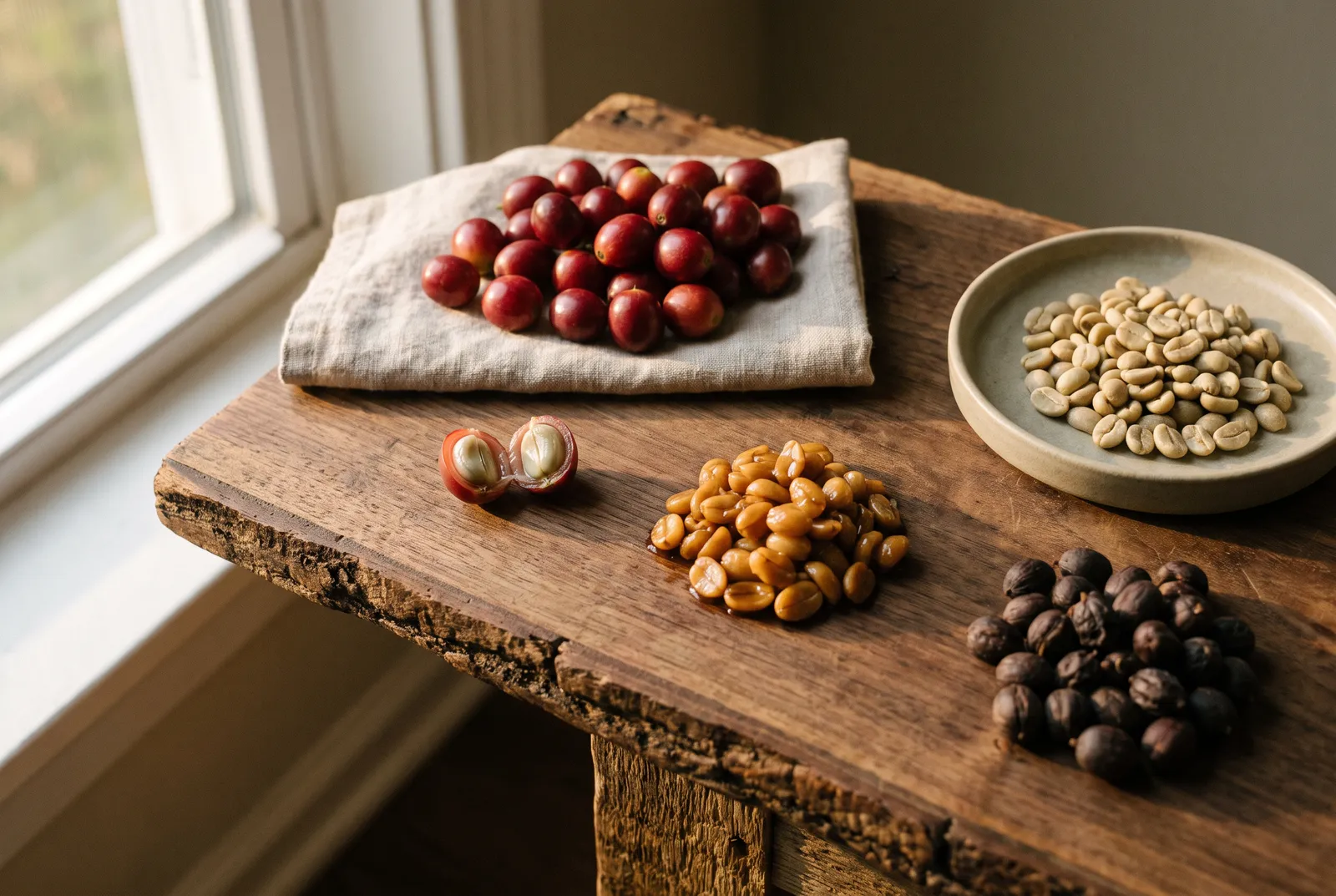
From the outside in, a ripe cherry has a thin skin, a layer of sweet pulp, a slippery and sugary layer called mucilage, a papery husk called parchment, a delicate silverskin and, finally, usually two seeds. Every processing method is a different answer to one question: how much of that fruit stays in contact with the seed, and for how long, while it dries?
Washed (wet) process
In the washed process, the skin and pulp are removed by machine soon after picking. The beans, still coated in mucilage, then sit in water tanks where fermentation loosens that sticky layer, which the NCA says can take 12 to 48 hours. The beans are washed clean and dried to about 11% moisture [1].
That tank fermentation is microbial. A 2017 study that followed coffee through processing found lactic acid bacteria such as Leuconostoc, Lactococcus and Lactobacillus dominating the wet process, alongside yeasts. Lactic acid, acetic acid, mannitol, ethanol and glycerol built up in the mucilage, and some of them made it into the bean itself; longer fermentation raised those levels, while the post-fermentation soak washed many of them back out [3].
Skipping fermentation is not a shortcut to cleaner coffee, either. One review notes that unfermented wet-processed beans are poorer in aromatic compounds and can even show sulfurous aromas [9]. The same review puts water use for wet processing at around 40 liters per kilogram [9], a real environmental cost in water-scarce regions.
In the cup: washed coffees tend to taste clean and transparent, often with floral or citrus notes [1]. If you love a bright, tea-like Kenyan or a lemony Ethiopian, you probably love washed coffee.
Natural (dry) process
Naturals are the simplest method in principle: pick the cherries and dry them whole. The NCA describes spreading cherries in the sun, turning them daily and covering them at night or in rain until they reach about 11% moisture, which can take several weeks depending on the weather [1]. The 2017 study cites 14 to 30 days as typical [3]. Drying temperatures matter, too; one review recommends keeping cherries below 45 °C during drying [9].
The microbes are different here. In the dry process, the 2017 study found acetic acid bacteria such as Acetobacter and Gluconobacter most abundant, along with a mix of yeasts. Gluconic acid and sugar alcohols piled up in the drying outer layers, with only minor amounts reaching the bean [3].
In the cup: naturals tend toward fuller body and sweet, fruity flavors, sometimes tipping into winey or fermented territory. Because whole cherries of mixed ripeness dry together, quality can be less consistent [1].
Why naturals taste like strawberries
The intuitive explanation, fruit juice soaking into the seed, does not hold up. SCA's science column points out that coffee fruit itself does not taste like strawberries or blueberries; the fruitiness comes from new aroma compounds formed after picking, as the cut-off fruit breaks down its own sugars and proteins and wild yeasts ferment them. Research by coffee scientist Mario Fernández-Alduenda linked two of these compounds to the familiar flavors: ethyl 2-methylbutanoate, with a strawberry-like taste, and ethyl 3-methylbutanoate, with a blueberry-like smell. Forming them takes both the breakdown and the fermentation [2]. Why some naturals turn out fruity and others do not remains an open question [2].
Honey (pulped natural, semi-dry) process
Honey processing sits between the two. The skin and pulp come off, but some or all of the mucilage stays on the beans while they dry [1]. No honey is involved; the name refers to that sticky layer. As the NCA puts it, leaving more mucilage generally produces a sweeter cup, while removing more brings it closer to a washed coffee [1]. One review adds that the semi-dry method notably enhances body and can bring caramel, fruity or herbal notes, with lower chlorogenic acid than dry processing and higher sucrose than either dry or wet [9].
Producers often name honey lots by color, and a 2025 study shows what those names can mean in practice. Researchers processed Arabica with five levels of mucilage left on: none as a control, about 20% for white honey, 50 to 60% for yellow, 75 to 80% for red, and all of it for black. They identified 257 volatile compounds, and the red honey beans had the highest overall volatile content, including the strongest contributions from linalool and the ionones, compounds associated with floral aromas [6]. The study measured chemistry and microbes rather than cup scores [6], and producers do not all define the colors the same way, so treat the color as a clue rather than a spec.
Anaerobic, carbonic maceration and the new wave
Over the past decade, producers have been moving from open-air fermentation toward closed tanks with controlled, low-oxygen conditions. A 2023 review of 74 studies describes exactly that migration and proposes classifying processes by how the fruit is treated, how much oxygen is available, whether water is added and whether starter cultures are used. Its sober conclusion: no single process reliably improves coffee quality or produces a predictable flavor in every environment, and well-defined protocols matter for food safety as well as flavor [10].
Anaerobic fermentation. In one low-cost version, self-induced anaerobic fermentation (SIAF), coffee ferments in a closed plastic tank fitted with an airlock that lets carbon dioxide out but keeps air from getting in. A 2022 Brazilian study compared 24, 48 and 72 hours. Longer fermentation increased esters such as ethyl and amyl acetate, plus terpenes, and ethanol in the green beans at 72 hours was about six times the 24-hour level. Every lot scored 84 points or more, and the longer fermentations improved aroma, flavor, acidity, body and balance. The authors caution that they studied one farm and one variety [7].
Carbonic maceration. Borrowed from Beaujolais-style winemaking, carbonic maceration ferments whole cherries in a sealed, carbon-dioxide-rich environment. In a 2024 study, researchers vacuum-sealed cherries, injected food-grade carbon dioxide and fermented them at 18, 28 or 38 °C for 24 to 120 hours. Temperature shaped the fungal community more than time did. At warmer temperatures and longer times, Fusarium molds increased, which the authors flag as a potential food-safety concern, and they describe the quality benefit of carbonic maceration as uncertain [8].
Everything else. Labels like yeast-inoculated, co-fermented and infused cover lots fermented with starter cultures or with added ingredients such as fruit or spices. The 2023 review notes that starter cultures play an important role in differentiating flavor [10]. Added ingredients are a different matter; if a bag tastes like cinnamon candy, it is fair to ask the roaster what went into the tank.
Wet-hulled. In Indonesia, especially Sumatra, many farms remove the parchment while the seed is still damp and finish drying the bare bean. The method is closely associated with the earthy, heavy-bodied, low-acid profile many drinkers know as Sumatra.
Processes at a glance
| Process | Fruit left on during drying | Fermentation and drying | Common flavor tendencies | Watch-outs |
|---|---|---|---|---|
| Washed | None | 12–48 h in tanks, dried to about 11% [1] | Clean, floral, citrus [1] | High water use, about 40 L/kg [9] |
| Natural | Whole cherry | Sun-dried for several weeks [1], often 14–30 days [3] | Sweet, fruity, fuller body, sometimes winey [1] | Uneven ripeness, overfermentation [1][9] |
| Honey | Some or all mucilage | Dried with mucilage on the parchment [1] | More sweetness and body [1][9] | Color names describe mucilage left, not a standard [6] |
| Anaerobic (SIAF) | Varies | Sealed tank with airlock, 24–72 h in one study [7] | Intensified fruit, more esters [7] | Needs tight control to repeat [10] |
| Carbonic maceration | Whole cherry | Sealed under CO2, 24–120 h at 18–38 °C in one study [8] | Fruity, winey [8] | Temperature control, mold risk [8] |
| Wet-hulled | Parchment removed while damp | Final drying on the bare bean | Earthy, heavy body, low acidity | Strong flavor imprint |
Why "fermented" and "funky" notes happen
Every process involves fermentation of some kind. Yeasts and bacteria feed on the fruit's sugars and produce acids, alcohols and aromatic compounds [2][3]. Most of the volatile compounds already present in green coffee do not survive roasting, according to a 2019 review, but compounds made by microbes during mucilage removal, including esters, higher alcohols, aldehydes and ketones, can be detected in the finished coffee [5]. That is the chemical path from the drying patio to the jammy, winey or tropical notes in your cup.
The seed contributes, too. Germination begins inside coffee seeds during standard processing, and how far it goes depends on the method, which helps explain why wet and dry processing produce different chemistry from the same cherries [4].
Then there is the line between funky and flawed. When fermentation is poorly controlled, running too short or too long, spoilage microbes can take over and produce butyric and propionic acids, which one review describes as an onion-like taste [9]. Acetic acid at high concentrations can taste unpleasant [7], and warm, long carbonic fermentations encouraged mold growth in one study [8]. Winey, boozy and tropical can be delicious. Vinegar, rot, solvent and onion are defects. Our flavor wheel maps the vocabulary, and how we score explains how we weigh it.
Tip: If you are new to naturals or anaerobic lots, start with a light or medium roast and brew it slightly cooler or at a slightly longer ratio. Intense fruit can read as harsh at high strength.
How to shop by process
- Want clarity and brightness? Look for washed coffees.
- Want fruit and sweetness? Try naturals. SCA notes they are traditionally associated with Ethiopia and Yemen but are now made in most coffee-growing countries [2].
- Somewhere in between? Honey process offers sweetness and body without as much ferment.
- Feeling adventurous? Anaerobic and carbonic maceration lots deliver the boldest flavors; good roasters will tell you fermentation times and whether anything was added.
Process character usually shows most clearly at lighter roasts. Browse our whole bean coffee and ground coffee listings, which note each coffee's process where the roaster discloses it, or explore the full directory.
Bottom line: Processing decides how long the seed sits with its fruit and its microbes. Washed tastes cleanest, natural tastes fruitiest, honey splits the difference, and anaerobic methods amplify everything, including mistakes. Read the process on the bag; it predicts flavor almost as well as the origin does.
FAQ
Is natural process coffee lower quality than washed?
No. A well-made natural can be clean, sweet and complex, and some of the most memorable coffees we taste are naturals. The process is simply harder to control: whole cherries dry slowly for weeks, and uneven ripeness or poor drying can lead to inconsistent or overfermented flavors. Washed coffees tend to taste cleaner and more transparent. Which you prefer is a matter of taste, not grade.
What does anaerobic mean on a coffee bag?
It usually means the cherries or depulped beans fermented in a sealed container with little or no oxygen, often fitted with a valve that lets carbon dioxide escape. There is no single standard, so times, temperatures and whether yeasts or other ingredients were added vary widely. Expect intense fruit and sometimes winey or boozy notes, and ask the roaster for details if they matter to you.
Why does some coffee taste boozy, winey or like vinegar?
During processing, yeasts and bacteria ferment the fruit's sugars into alcohols, acids and fruity esters, and some of those compounds survive roasting. In moderation they read as winey, tropical or jammy. Pushed too far, or poorly controlled, fermentation produces vinegary, solvent-like or onion-like defects. Natural, anaerobic and carbonic maceration lots are the most likely to show these notes, for better or worse.
Does honey process coffee contain honey?
No. The name refers to the sticky, sugary mucilage that coats the seed after the skin and pulp are removed. In honey processing, some or all of that layer is left on while the beans dry. Producers often describe the amount with colors, from white or yellow honey with less mucilage to red and black honey with more, though definitions vary between farms.
References
- [1]Processes — National Coffee Association
- [2]Coffee Decoded: What Makes Fruit-Dried Coffees Taste Fruity? — Specialty Coffee Association
- [3]Exploring the Impacts of Postharvest Processing on the Microbiota and Metabolite Profiles during Green Coffee Bean Production — Applied and Environmental Microbiology, via PubMed Central
- [4]Germination of coffee seeds and its significance for coffee quality — Plant Biology, via PubMed
- [5]Exploring the impacts of postharvest processing on the aroma formation of coffee beans - A review — Food Chemistry, via PubMed
- [6]Characterization of volatile compounds and microbial diversity of Arabica coffee in honey processing method based on different mucilage retention treatments — Food Chemistry: X, via PubMed Central
- [7]Understanding the Effects of Self-Induced Anaerobic Fermentation on Coffee Beans Quality: Microbiological, Metabolic, and Sensory Studies — Foods (MDPI), via PubMed Central
- [8]Genetic diversity of the fungal community that contributes to the sensory quality of coffee beverage after carbonic maceration and fermentation — 3 Biotech, via PubMed Central
- [9]Influence of pre-and post-harvest factors on the organoleptic and physicochemical quality of coffee: a short review — Journal of Food Science and Technology, via PubMed Central
- [10]Coffee fermentation process: A review — Food Research International, via PubMed
Discussion
What do you think?
No discussions yet.
Own this article? Ask a question or share your recipe — you’ll be the first.