Cold coffee isn't a summer side menu anymore. In the National Coffee Association's fall 2026 survey, cold or iced coffee made up 21% of the coffee Americans drank the previous day, up from 16% in 2022. Past-week cold brew drinking also climbed to 21% [10]. But "cold coffee" covers several drinks that are made differently, taste different and carry different amounts of caffeine. Here's how they compare, why, and how to make each one well at home.
The main ways to make coffee cold
| Method | How it's made | Time | Flavor tendency | Best for |
|---|---|---|---|---|
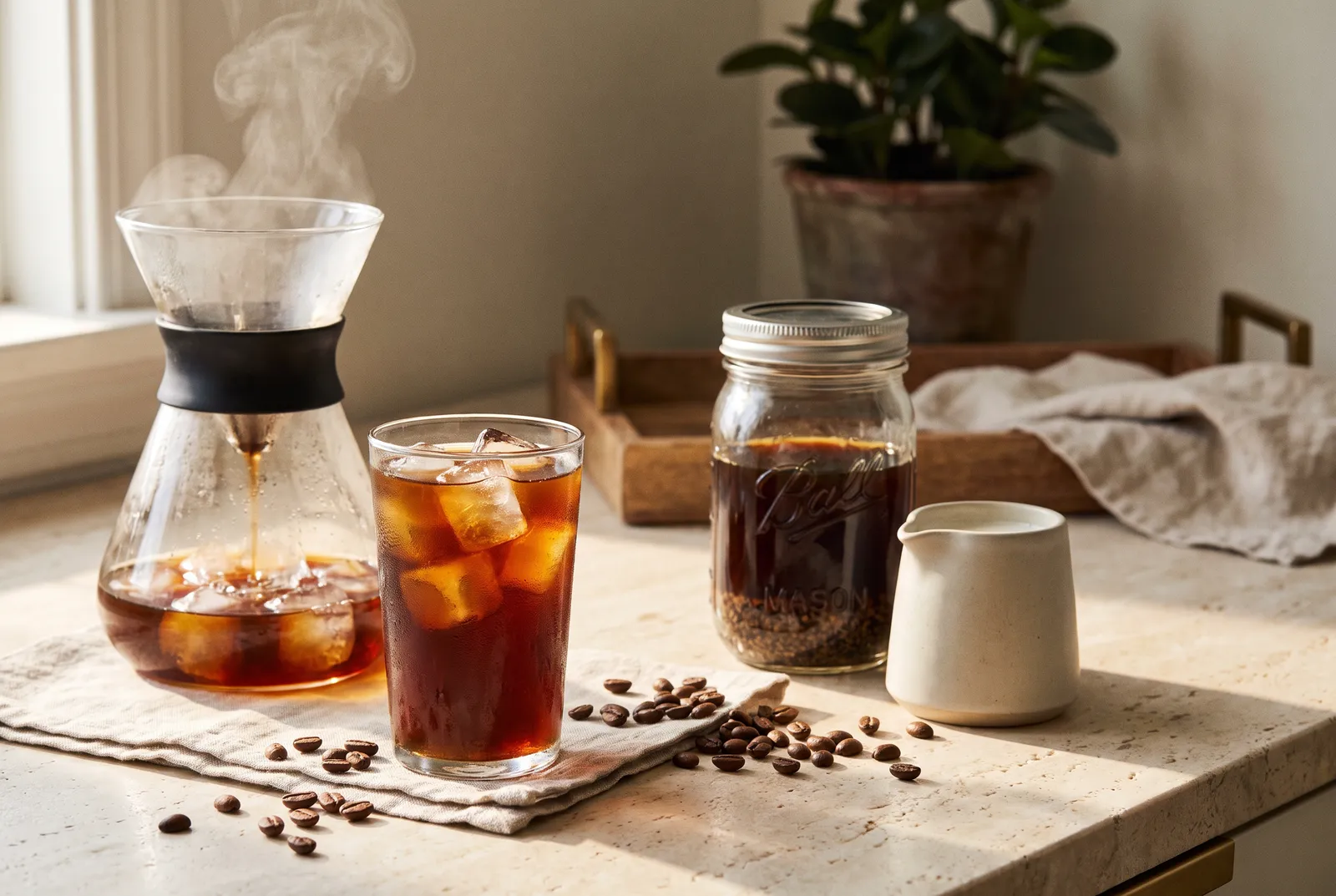
| Cold brew | Coarse grounds steeped in cold or room-temperature water, then filtered | 6–18+ hours | Round, low bitterness, chocolatey, sometimes floral | Batch prep; smooth black coffee; milk drinks |
| Flash brew (Japanese-style iced) | Pour-over brewed hot directly onto ice | A few minutes | Bright, aromatic, fruit-forward | Showcasing light roasts |
| Classic iced coffee | Hot coffee, often brewed strong, chilled or poured over ice | Minutes to hours | Can taste flat or diluted if chilled slowly | Using a drip machine |
| Ready-to-drink (cans, bottles) | Factory-brewed, processed for shelf life or kept refrigerated | None for you | Varies; processing can add cooked notes | Convenience |
| Concentrates (liquid or frozen) | Extra-strong extract you dilute | Seconds | Varies by maker | Fast lattes; adjustable strength |
The chemistry: temperature changes what dissolves
Hot water pulls flavor compounds out of coffee quickly. Cold water does it slowly, so cold brew relies on time. Researchers at Thomas Jefferson University tracked that process at room temperature (21–25 °C). Caffeine and the main chlorogenic acid reached equilibrium in about 6–7 hours. Medium roasts produced more of both than dark roasts. Grind size made no significant difference over long steeps, because there was enough time for diffusion to finish [2].
Acidity: what's true and what isn't
"Low acid" is the most repeated cold brew claim, and the evidence is more nuanced than the marketing.
- pH is about the same. Brewing the same six coffees at the same 1:10 ratio, the researchers measured cold brew at pH 4.96–5.13 and hot brew at 4.85–5.10, which they called comparable [1].
- Total titratable acids can be lower. The same study found higher titratable acidity in the hot brews, suggesting hot water extracts more acid compounds overall. Hot brews also showed higher antioxidant activity [1].
- It tastes less sour, and less bitter. A UC Davis sensory study took a cleaner approach. Coffees were brewed at 4 °C, 22 °C and 92 °C to equilibrium, then diluted to the same strength (2% total dissolved solids) and served at the same cold temperature. Trained panelists rated the hot brews more bitter, sour and "rubbery," and the cold brews more floral. Sweetness didn't differ significantly, and the two cold temperatures tasted much alike [3]. In that study, pH was lower in the hot brews while titratable acidity barely moved [3]. Different labs, different acid numbers, but the same consistent finding on taste.
Bottom line: Cold brew tastes gentler. It isn't a low-acid beverage in any chemical sense. If you love it, it's for the flavor, and that's reason enough.
Caffeine: it's the ratio, not the method
Given enough time, cold water extracts caffeine about as completely as hot water does [2]. What changes the dose in your glass is how much coffee went into it and how much you dilute it.
- The FDA puts a 12-ounce cup of regular brewed coffee at about 113–247 mg of caffeine, and uses 400 mg a day as a level not generally linked to negative effects for most adults [4].
- At a strong 1:10 ratio, room-temperature cold brew held roughly 990–1,230 mg of caffeine per liter after 24 hours [2]. That works out to about 235–290 mg in an undiluted 8-ounce glass. For coarse grinds, cold brew actually carried more caffeine than the same coffee hot-brewed at that ratio, for example 1,230 vs. 970 mg/L for a medium roast [2].
- Cafés and canned drinks vary widely, and packaged coffee generally doesn't have to state caffeine in milligrams. The FDA has put caffeine-labeling guidance on its 2026 agenda, but it isn't a requirement yet [8]. When it matters to you, look up the brand's number.
Concentrate math
Home concentrates usually fall somewhere between about 1:4 and 1:8, coffee to water by weight. Dilute to taste. These starting points land near ordinary drip strength:
| Concentrate ratio | Starting dilution (concentrate : water or milk) | Result |
|---|---|---|
| 1:4 | 1:2 to 1:3 | Near drip strength; very flexible |
| 1:5 to 1:6 | About 1:1.5 to 1:2 | Near drip strength |
| 1:8 | 1:1 (Counter Culture's suggestion [6]) | Near drip strength |
| Any concentrate, undiluted | None | Roughly double or more the caffeine of a normal cup |
Watch out: Undiluted concentrate over ice looks like a normal iced coffee and can carry two or three cups' worth of caffeine. Label your jar with the ratio.
How to make each at home
Cold brew concentrate
Counter Culture's recipe makes about 15 servings [6]:
- Grind 200 g of coffee medium-coarse, like kosher salt.
- Bloom the grounds with 300 g of water at 170 °F, stir gently and wait 3 minutes.
- Add 1,300 g of room-temperature water (1,600 g total, a 1:8 ratio), cover and refrigerate for at least 6 hours.
- Drain and filter.
- Serve 1:1 with cold water over ice, or 2 oz of concentrate with 6 oz of milk for an iced latte.
Extraction slows in the cold, so we usually let it go 12–16 hours. For a cleaner cup, run the finished concentrate through a paper filter.
Flash brew (Japanese-style iced)
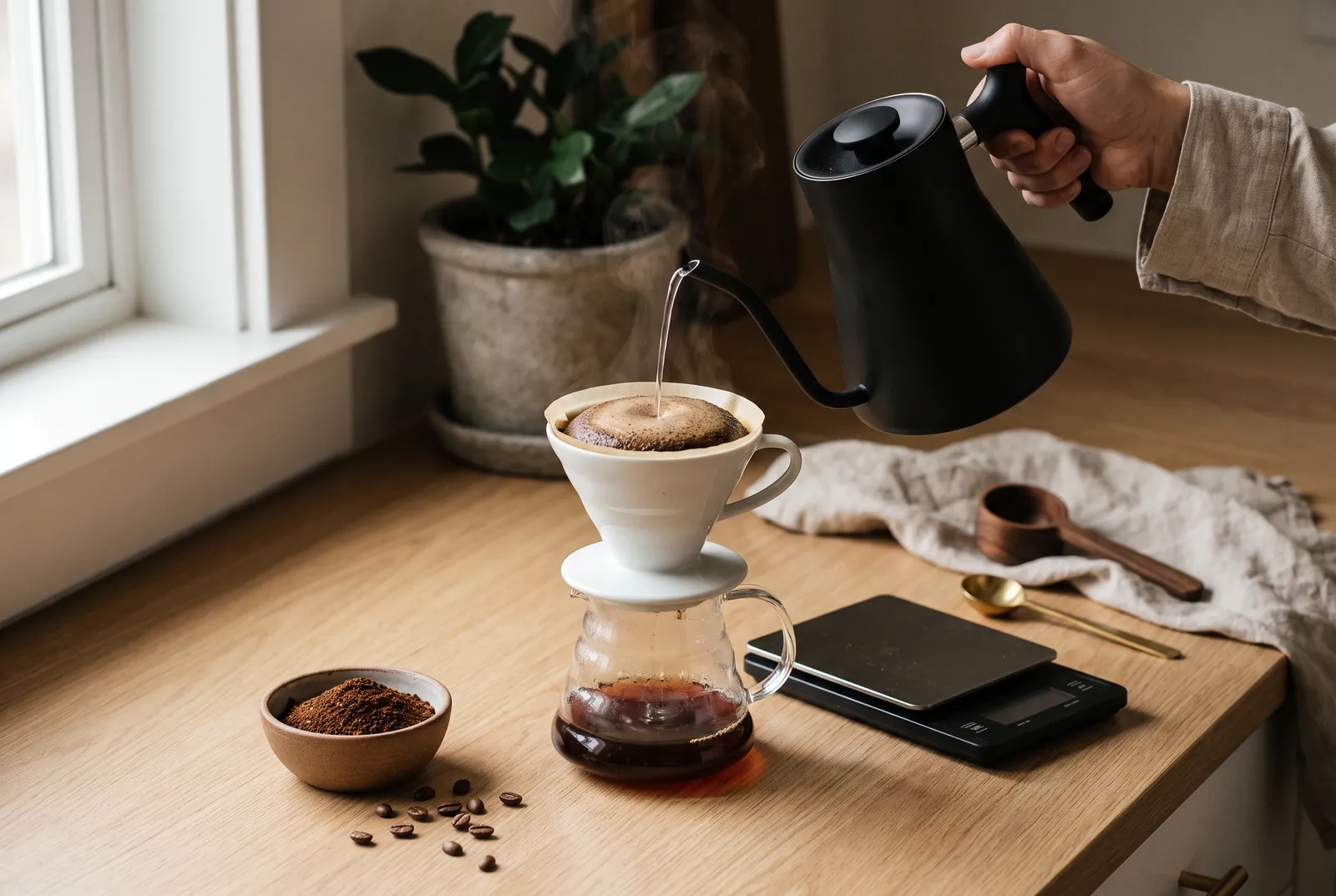
This is the best way to taste a bright, fruity coffee cold. Counter Culture's version makes one 16-ounce drink [5]:
- Put 165 g of ice in the carafe.
- Grind 30 g of coffee medium-fine, like table salt.
- Heat 335 g of water to 200 °F.
- Bloom with 30 g of water. At 0:30, pour to 100 g. Around 1:00, pour to 200 g, then keep pouring in stages to 335 g.
- Swirl and pour over fresh ice.
The logic is simple. About a third of the total liquid is ice, so the hot portion is brewed strong (1:11 here) and lands near normal strength once the ice melts, about 1:17 overall. Grinding a little finer compensates for the smaller volume of hot water.
Classic iced coffee from a drip machine
Put ice in the carafe and brew with roughly the same coffee dose but less water, or brew at double strength into a carafe of ice. Avoid chilling leftover hot coffee for hours. It tends to taste flat and papery.
Tip: Brew flash coffee with washed, light-roast coffees, which showcase florals and citrus. Use cold brew for chocolatey, nutty or natural-process coffees, where muted acidity is a feature. Find candidates in whole bean coffee and put words to what you taste with the flavor wheel.
Cans, cartons and concentrates
Store-bought cold coffee has to solve a food-safety problem first. U.S. regulations define low-acid foods as those with a finished pH above 4.6 and water activity above 0.85 [7]. Coffee, at roughly pH 5 [1], falls on the low-acid side. That's why shelf-stable coffee in sealed containers goes through validated heat or aseptic processing, while fresh cold brew lives in the refrigerated case. Mother Parkers' new extract plant, for instance, uses aseptic processing so products stay shelf-stable until opened, and its formats include concentrates as strong as 48:1 [9].
What that means when you shop:
- Shelf-stable cans and cartons trade some aroma for convenience. Heat processing can add cooked or muted notes, so taste a few brands.
- Refrigerated cold brew tends to taste fresher. Respect the use-by date and keep it cold after opening.
- Concentrates give you control over strength. Check whether the label gives a dilution ratio, and remember that undiluted concentrate is potent.
- Caffeine often isn't on the label [8], so look it up if you're counting.
The category keeps growing. Technomic forecasts U.S. foodservice cold coffee volume to grow about 6.2% a year from 2025 to 2030 [9]. Among Americans, past-week nitro coffee drinking reached 7% in the fall 2026 survey, and ready-to-drink coffee accounted for 17% of past-day preparation [10]. Browse options in cold brew and RTD and concentrates.
Which should you make?
| If you want... | Choose | Why |
|---|---|---|
| Bright, aromatic, fruity iced coffee | Flash brew | Hot extraction keeps aromatics; ice locks them in fast |
| Smooth, low-bitterness black coffee | Cold brew | Less perceived sourness and bitterness [3] |
| A week of iced coffee with little daily effort | Cold brew concentrate | One batch, many servings [6] |
| Milk-forward iced lattes | Concentrate or cold brew | Strong base that survives milk |
| Grab and go | Ready-to-drink | No prep, at a higher cost per cup |
Storage and safety at home
- Steep in the refrigerator, as Counter Culture does [6], rather than on a warm counter overnight.
- Store finished cold brew in a clean, sealed jar in the fridge. Flavor fades over several days, so make batches you'll finish within about a week.
- Never treat homemade cold brew as shelf-stable. It's a low-acid liquid [7] without the processing that makes cans safe at room temperature.
- Clean your brewer and filters thoroughly between batches. Old grounds and oils go stale and sour.
Shopping for gear? Compare cold brew makers and pour-over brewers in coffee makers and brewers.
Bottom line: Pick by flavor. Flash brew for brightness, cold brew for smoothness, concentrates and cans for convenience. Then control caffeine with the ratio and dilution, not the method.
FAQ
Is cold brew less acidic than hot coffee?
Not by pH. In controlled comparisons, cold brew and hot brew from the same beans landed at similar pH, roughly 4.9 to 5.1 in one study. Some studies measured fewer total titratable acids in cold brew, and trained tasters rated it less sour and less bitter. So cold brew tastes gentler, but it isn't a low-acid drink in any chemical sense.
Does cold brew have more caffeine than iced coffee?
Only if it's stronger. Caffeine depends mostly on how much coffee goes into each ounce. At the same 1:10 ratio, one study found coarse-ground cold brew held somewhat more caffeine than the hot version. But concentrates are often diluted 1:1 or more. A diluted 1:8 concentrate is roughly drip-strength, while drinking it straight can roughly double the caffeine.
How long should I steep cold brew?
At room temperature, caffeine and the main chlorogenic acid plateau in about six to seven hours, so very long counter steeps add little. In the refrigerator, extraction is slower. Counter Culture's recipe calls for at least six hours, and we like 12 to 16 hours for a fuller concentrate. Taste along the way, then filter and keep it cold.
Can I just chill leftover hot coffee?
You can, but it usually tastes flat and papery because aromatics fade and the coffee keeps changing as it slowly cools. For better iced coffee, brew hot coffee directly onto ice so it chills in seconds. Use about a third of your total water as ice and grind slightly finer to keep the extraction on track.
References
- [1]Acidity and Antioxidant Activity of Cold Brew Coffee — Scientific Reports (2018), via PubMed Central
- [2]The Effect of Time, Roasting Temperature, and Grind Size on Caffeine and Chlorogenic Acid Concentrations in Cold Brew Coffee — Scientific Reports (2017), via PubMed Central
- [3]Sensory Analysis of Full Immersion Coffee: Cold Brew Is More Floral, and Less Bitter, Sour, and Rubbery Than Hot Brew — Foods (2022), via PubMed Central
- [4]Spilling the Beans: How Much Caffeine is Too Much? — U.S. Food and Drug Administration
- [5]Flash Brew — Counter Culture Coffee
- [6]Cold Brew — Counter Culture Coffee
- [7]21 CFR § 113.3 - Definitions — Legal Information Institute, Cornell Law School (Code of Federal Regulations)
- [8]FDA Eyes Caffeine Labeling as a 2026 Priority — Daily Coffee News by Roast Magazine
- [9]Mother Parkers Expands Into Coffee Extract Manufacturing — Daily Coffee News by Roast Magazine
- [10]NCA: More Americans Are Drinking Specialty Coffee and Ordering by App — Daily Coffee News by Roast Magazine
Discussion
What do you think?
No discussions yet.
Own this article? Ask a question or share your recipe — you’ll be the first.